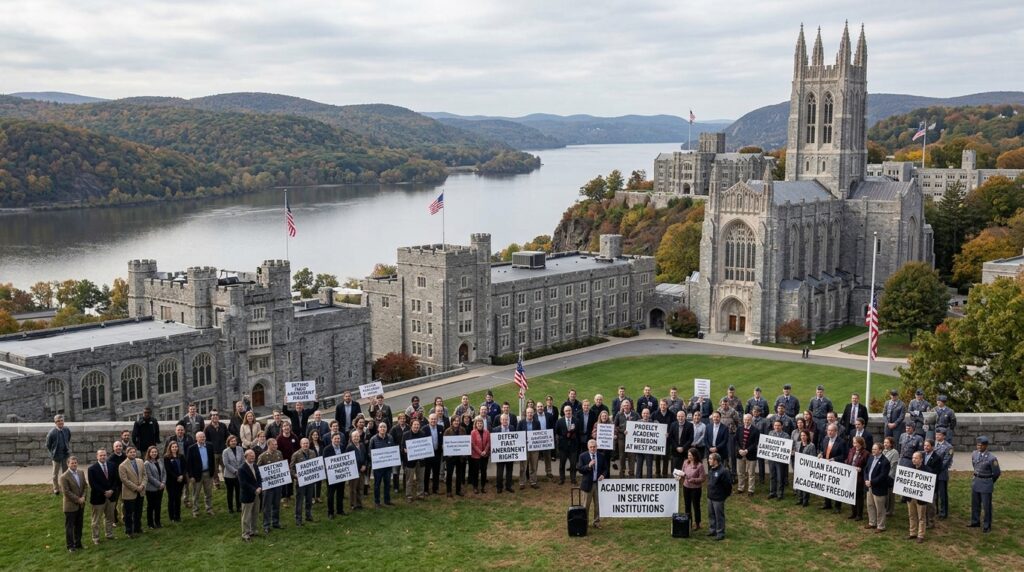

In an era where debates over academic freedom rage across college campuses, a high-stakes lawsuit at the U.S. Military Academy at West Point raises unique questions. What happens when civilian professors at a federal service academy challenge restrictions on their speech? The West Point professor lawsuit, filed by longtime law professor Tim Bakken, spotlights the tension between institutional control and First Amendment rights.
This class-action effort, filed in September 2025, accuses West Point of imposing unconstitutional limits on civilian faculty. It examines whether military academy regulations can override core constitutional protections for educators who are not active-duty military. For legal professionals, constitutional scholars, and higher education leaders, this case offers critical insights into academic freedom in unique federal settings.
Background of the West Point Professor Lawsuit
The controversy centers on policies implemented in early 2025. West Point issued Dean’s Policy & Operating Memorandum No. 03-24 (DPOM 03-24) in February. This required civilian faculty to obtain prior approval from department heads before engaging in public speaking or publishing while identifying with the academy.
An additional informal directive reportedly barred professors from sharing personal opinions in the classroom. Tim Bakken, the longest-serving law professor in West Point’s history (teaching since 2000), filed suit in the U.S. District Court for the Southern District of New York on September 22, 2025. He named the academy and senior officials as defendants.
Bakken seeks class-action status on behalf of roughly 100 civilian faculty members. The complaint argues these rules create a prior restraint on speech and amount to viewpoint discrimination. It ties the policies to broader Department of Defense and executive actions aimed at aligning institutional messaging.
Civilian faculty at military academies occupy a hybrid role. They bring academic expertise without full military command structures, yet they operate within a disciplined environment. This lawsuit tests the boundaries of that balance.
Key Legal Claims and First Amendment Implications
At its core, the West Point professor lawsuit revolves around First Amendment rights. The First Amendment prohibits government from abridging freedom of speech. Courts apply stricter scrutiny to prior restraints, which require approval before speech occurs.
Bakken contends DPOM 03-24 functions as an impermissible licensing regime. Faculty must seek permission for external engagements on topics within their expertise. Critics argue this chills speech by inviting viewpoint-based denials.
The lawsuit also challenges classroom restrictions. Forbidding professors from expressing opinions on subjects they teach strikes at the heart of academic freedom. In higher education, the ability to engage students with diverse perspectives fosters critical thinking, essential for future military leaders.
Constitutional Precedents in Play
Courts have long recognized academic freedom as a special concern of the First Amendment. Key cases include:
- Keyishian v. Board of Regents (1967): The Supreme Court struck down loyalty oaths and vague restrictions on faculty speech, emphasizing that academic settings require robust debate.
- Garcetti v. Ceballos (2006): This ruling limited public employees’ speech rights when speaking pursuant to official duties. However, it left room for academic exceptions, which Bakken’s team highlights for civilian professors.
Military contexts add complexity. Parker v. Levy (1974) upheld restrictions on military speech due to the need for discipline. Yet civilian faculty differ from uniformed personnel. They lack the same chain-of-command obligations.
The suit argues that viewpoint-neutral policies might survive, but content- or viewpoint-based ones do not. Evidence of selective enforcement, such as removing certain books or courses, bolsters claims of discrimination.
Timeline and Court Developments
- January 2025: Executive Order 14185, “Restoring America’s Fighting Force,” prompts reviews of faculty activities.
- February 13, 2025: DPOM 03-24 issued.
- September 22, 2025: Bakken files federal lawsuit seeking class action and injunction.
- May 26, 2026: U.S. District Judge Cathy Seibel grants a preliminary injunction. The court blocks enforcement of the prior-approval policy against civilian faculty and prohibits restricting Bakken from sharing opinions in class.
This ruling represents a significant early victory for free speech advocates. The judge found likely success on the merits regarding First Amendment violations. The case continues toward a permanent resolution, potentially setting nationwide precedents for civilian faculty rights in federal service academies.
Academic Freedom vs. Military Academy Regulations
Military academy regulations serve legitimate interests: maintaining good order, discipline, and national security. Faculty speech that undermines mission readiness or reveals classified information could face limits. However, broad prophylactic rules risk overreach.
Civilian professors contribute specialized knowledge in law, history, engineering, and social sciences. Suppressing their ability to discuss controversial topics in class or externally could weaken the intellectual rigor of cadet education. Future officers benefit from exposure to rigorous debate rather than sanitized viewpoints.
This case echoes broader debates over academic censorship in public institutions. Unlike private universities with greater leeway, federal academies face direct constitutional constraints as government actors.
Potential Broader Impacts
A win for Bakken could influence policies at other service academies (Naval Academy, Air Force Academy). It might clarify Department of Defense policies on faculty expression. Administrators nationwide could revisit speech codes to avoid similar challenges.
Conversely, if courts uphold significant restrictions, it might reinforce institutional authority in military education settings. Legal scholars will watch how the balance between academic freedom and operational needs evolves.
Challenges for Civilian Faculty in Federal Institutions
Civilian faculty at places like West Point navigate unique pressures. They enjoy many academic freedoms but operate under federal employment rules and security considerations.
Common issues include:
- Prior approval requirements for media appearances or publications.
- Limits on expressing personal views that might conflict with current policy.
- Potential retaliation through contract non-renewal or altered duties.
The West Point professor lawsuit highlights risks of self-censorship. Professors may avoid controversial topics to evade scrutiny, diminishing educational quality.
For constitutional law practitioners, this underscores the importance of clear policies. Vague standards invite abuse and constitutional challenges. Institutions should craft narrow, viewpoint-neutral rules that directly advance compelling interests.
What This Means for Higher Education and Civil Liberties
This lawsuit arrives amid heightened national scrutiny of campus speech. While many focus on student protests or DEI policies, the West Point case addresses faculty rights in a structured, mission-driven environment.
Civil liberties advocates see it as a test of whether core protections extend to government-employed educators. Higher education administrators at public institutions should review their own policies for similar vulnerabilities.
Military history enthusiasts and academy alumni have a stake too. West Point’s strength lies in producing thoughtful, principled leaders. Robust academic discourse strengthens that mission rather than undermining it.
Practical Considerations and Next Steps
Observers should monitor further proceedings in the Southern District of New York. Potential appeals could reach higher courts, including the Supreme Court if significant constitutional questions persist.
For those in similar positions:
- Document any speech-related restrictions or adverse actions.
- Consult counsel familiar with First Amendment litigation in public employment.
- Review institutional handbooks against constitutional standards.
Legal precedents evolve through cases like this one. Staying informed helps advocates and administrators navigate the intersection of duty and liberty.
Conclusion
The West Point professor lawsuit represents more than one professor’s grievance. It probes fundamental questions about free speech restrictions and academic freedom in America’s premier military institutions. The preliminary injunction signals judicial recognition of strong constitutional claims, but the full resolution will shape policy for years.
As the case advances, it reminds us that even in disciplined settings, the marketplace of ideas remains vital. Protecting robust discourse ultimately serves the academy’s goal of developing informed, ethical leaders.


