
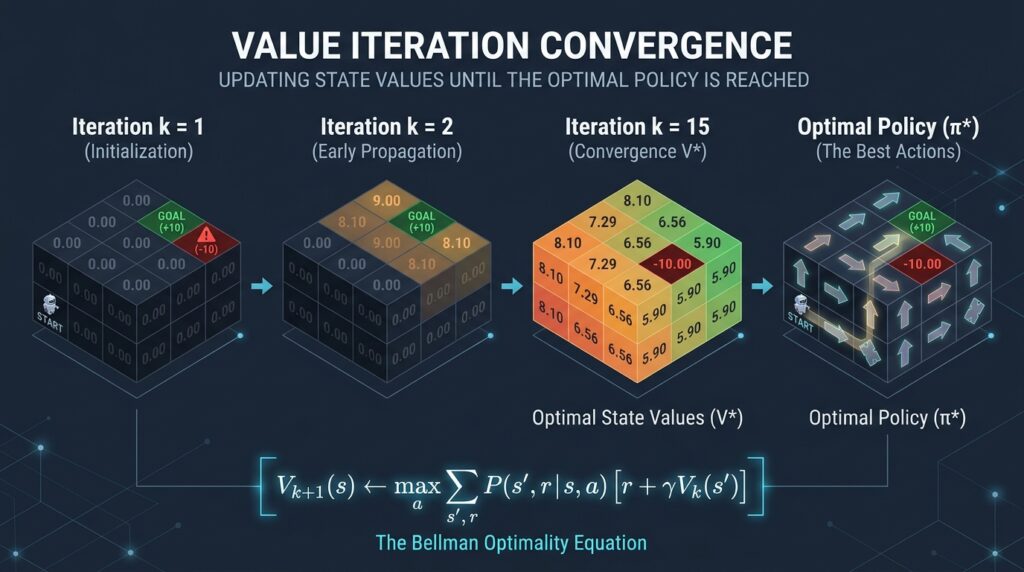

Reinforcement learning sits at the heart of modern artificial intelligence, and one of its most foundational algorithms is value iteration. Whether you are studying on your own or enrolled in an artificial intelligence course in Mumbai, understanding how value iteration converges to an optimal policy is essential for building intelligent, decision-making systems. This article breaks down the concept clearly, from the basics of state values to the conditions under which convergence is guaranteed.
What Is Value Iteration?
Value iteration is a dynamic programming algorithm used in reward-based learning to compute the optimal value function for a Markov Decision Process (MDP). An MDP models an environment where an agent takes actions, transitions between states, and receives rewards. The goal is to find a policy — a plot from states to actions — that increases the agent’s cumulative reward over time.
The algorithm works by repeatedly updating the estimated value of each state based on the expected rewards and the values of neighbouring states. At each iteration, the agent applies the Bellman optimality equation:
V(s) = max_a [ R(s, a) + γ Σ P(s’|s, a) V(s’) ]
Here, V(s) is the value of state s, R(s, a) is the immediate reward, γ is the discount factor, and P(s’|s, a) is the transition probability. The process repeats until the values stabilize — that is, until convergence is reached.
How Convergence Works
Convergence in value iteration means that successive updates to the value function produce smaller and smaller changes. Formally, the algorithm has converged when the maximum difference between the old and new value estimates falls below a small threshold (ε).
This is guaranteed to happen because the Bellman operator is a contraction mapping. In simple terms, each application of the update rule brings the current value function closer to the true optimal value function. The rate of convergence depends primarily on the discount factor γ. A smaller γ (closer to 0) causes faster convergence because future rewards are discounted heavily, reducing the influence of distant states. A γ closer to 1 slows convergence but gives the agent a longer planning horizon.
In practice, most implementations run value iteration until the change in values drops below a predefined tolerance, such as 0.001, rather than waiting for mathematically perfect convergence.
Deriving the Optimal Policy
Once the value function has converged, extracting the optimal policy is straightforward. For every state, the agent simply selects the action that increases the right-hand side of the Bellman equation:
π(s) = argmax_a [ R(s, a) + γ Σ P(s’|s, a) V(s’) ]**
This policy is greedy with respect to the converged value function V*. Because value iteration guarantees convergence to the true optimal value function (given sufficient iterations), the resulting policy is also optimal — it produces the highest possible long-term reward for the agent in that environment.
This step-by-step approach — iteratively refine values, then extract the policy — is what makes value iteration both elegant and practical. It is a staple topic in any structured artificial intelligence course Mumbai because it builds intuition for more advanced algorithms like Q-learning and policy gradient methods.
Limitations and Practical Considerations
While value iteration is theoretically sound, it faces real-world challenges. The most significant is scalability. The algorithm must update the value of every state at every iteration, which becomes computationally expensive when the state space is large or continuous. This is known as the “curse of dimensionality.”
To address this, practitioners use approximations such as function approximation (e.g., neural networks) to estimate value functions without enumerating every state. Deep Q-Networks (DQN), for example, extend the core idea of value iteration to high-dimensional problems like video game environments.
Additionally, value iteration assumes complete knowledge of the environment’s transition probabilities and reward structure. In real-world settings, this information is rarely available, which is why model-free methods like Q-learning are often preferred.
Conclusion
Value iteration is a cornerstone of reinforcement learning and a clear demonstration of how iterative mathematical reasoning leads to optimal decision-making. By repeatedly applying the Bellman update and waiting for the value function to stabilize, an agent can derive a policy guaranteed to maximize long-term reward. Whether you encounter it in academic research or as part of an artificial intelligence course Mumbai, mastering value iteration provides the conceptual foundation needed to understand modern AI systems. Start with small, well-defined MDPs, observe how values shift across iterations, and gradually build toward more complex environments.