
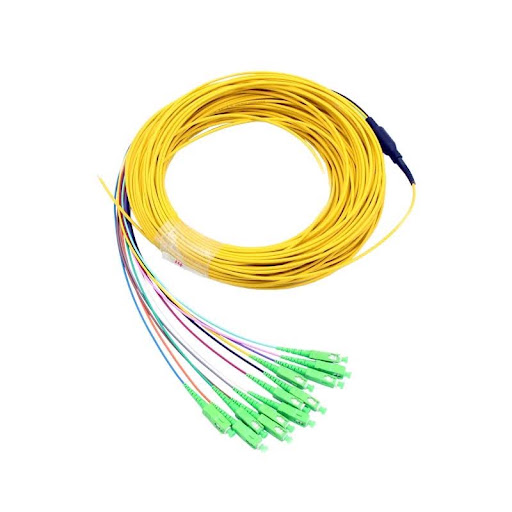

A fiber pigtail is a short length of optical fiber cable with a connector on one end and exposed fiber on the other. It is widely used in fiber optic networks to connect optical fibers with equipment, patch panels, splice closures, and other components. Because of its simple design and reliable connection method, fiber pigtails are an important part of modern telecommunications and data communication systems.
Fiber optic networks require precise connections to maintain signal quality. A fiber pigtail provides a practical way to terminate and connect optical fibers while supporting efficient installation and maintenance.
What Is a Fiber Pigtail?
A fiber pigtail consists of a short fiber optic cable that has a factory-installed connector on one side. The other side contains bare fiber that can be spliced to another fiber cable.
The connector allows the pigtail to connect with equipment or adapters, while the exposed fiber is normally joined to the main fiber cable through fusion splicing. This combination creates a reliable and low-loss connection.
Fiber pigtails are available with different connector types, fiber modes, and cable constructions to meet different network requirements.
How Does a Fiber Pigtail Work?
The main purpose of a fiber pigtail is to provide a convenient termination point for an optical fiber. During installation, the exposed end of the pigtail is aligned and spliced with the fiber from a cable.
Fusion splicing is commonly used because it creates a permanent connection with low insertion loss. Once the splice is completed, the connection can be protected inside a splice tray or closure.
The connector on the opposite end can then be connected to an optical device, adapter, patch panel, or other network component.
This design reduces the complexity of terminating large fiber cables directly and helps installers achieve consistent connection quality.
Types of Fiber Pigtails
Fiber pigtails can be classified according to several factors.
Single-Mode Fiber Pigtails
Single-mode pigtails are designed for long-distance communication. They are commonly used in telecommunications, fiber-to-the-home networks, metropolitan networks, and other applications where signals must travel over significant distances.
Multimode Fiber Pigtails
Multimode pigtails are generally used for shorter-distance communication. They can be found in enterprise networks, data centers, local area networks, and other environments where high-speed communication is required over shorter fiber runs.
Simplex Fiber Pigtails
A simplex pigtail contains one optical fiber. It is suitable for applications where a single fiber is required for communication or a particular network connection.
Duplex Fiber Pigtails
Duplex pigtails contain two fibers and are often used for applications requiring separate transmit and receive paths.
Common Connector Types
Fiber pigtails are available with several connector designs. Common options include LC, SC, ST, and FC connectors.
LC connectors are compact and useful where installation space is limited. They are frequently used in data centers and high-density network environments.
SC connectors have a larger push-pull design and are commonly used in telecommunications and fiber distribution systems.
ST connectors use a bayonet-style locking mechanism and are found in some older networking installations.
FC connectors use a threaded connection and are often selected for applications requiring strong mechanical stability.
The appropriate connector depends on the equipment and adapter used in the network.
Benefits of Using Fiber Pigtails
One of the main advantages of a fiber pigtail is installation convenience. Since the connector is factory terminated, installers do not need to terminate the connector on-site.
Another advantage is consistent quality. Factory termination can provide controlled connector performance, while the exposed fiber is prepared for professional splicing.
Fiber pigtails also make network maintenance easier. If a connection needs to be replaced, technicians can work with standardized connectors and splice arrangements.
Other benefits include:
- Reliable optical connections
- Low insertion loss when properly installed
- Easy integration with fiber panels
- Multiple connector options
- Availability for single-mode and multimode networks
- Efficient fiber cable termination
- Suitable for many network architectures
Applications of Fiber Pigtails
Fiber pigtails are used in many types of optical networks. Telecommunications companies use them in fiber distribution systems and network cabinets. Internet service providers can use them in fiber access networks and subscriber connections.
They are also common in data centers, enterprise networks, security systems, industrial communication networks, and fiber optic testing environments.
Inside a fiber distribution panel, pigtails can connect incoming fiber cables to adapters and equipment. In splice closures, they can provide organized termination points for optical fibers.
Choosing the Right Fiber Pigtail
Several factors should be considered when selecting a fiber pigtail.
First, determine whether the network requires single-mode or multimode fiber. The connector type should also match the equipment or adapter.
Fiber length, fiber count, cable diameter, connector polishing type, and operating environment are also important considerations.
For outdoor applications, installers should consider environmental protection and suitable cable construction. Indoor applications may require a different cable design that is easier to route through racks and cabinets.
It is also important to purchase pigtails from a manufacturer or supplier that follows appropriate manufacturing and quality-control practices.
Installation and Maintenance
Proper handling is essential when installing fiber pigtails. Optical fiber is sensitive to dirt, dust, excessive bending, and physical damage.
Connectors should be kept clean and protected when they are not being used. Technicians should also follow the recommended minimum bend radius of the fiber cable.
Fusion splicing should be performed with appropriate equipment and according to installation procedures. After splicing, the joint should be protected using a suitable splice protection sleeve.
Regular inspection and cleaning can help maintain reliable optical performance.
Conclusion
A fiber pigtail provides a simple and effective method for connecting optical fiber cables to network equipment and distribution systems. Its factory-installed connector and splice-ready fiber end make it useful for telecommunications, data centers, enterprise networks, and many other applications.
By selecting the correct fiber type, connector, cable construction, and length, network installers can create organized and reliable fiber connections. Proper installation, cleaning, and handling are also important for maintaining long-term performance.


