
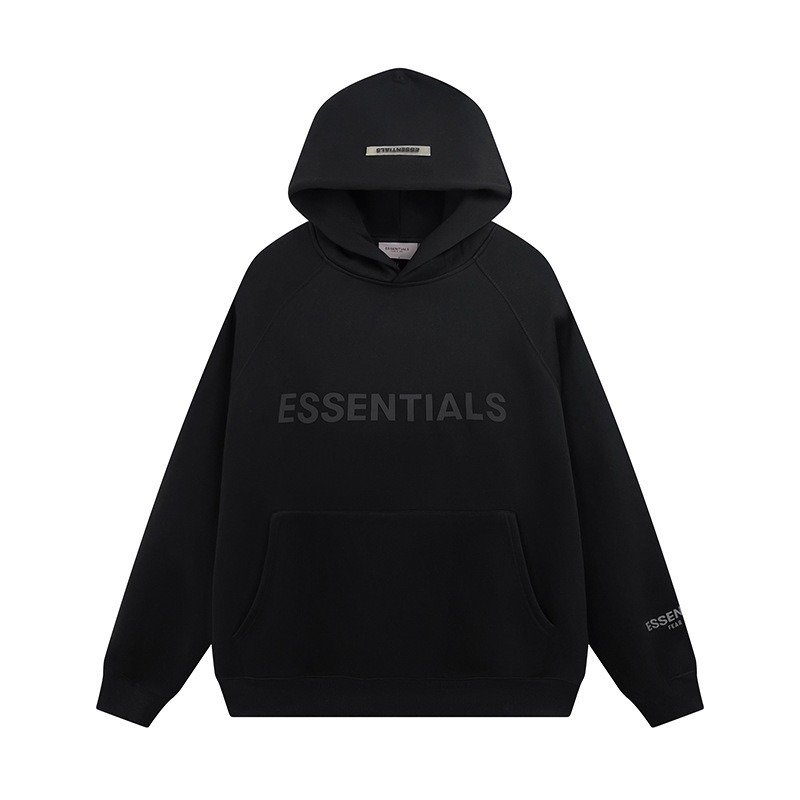
Shoulders are where hoodie sizing quietly falls apart. A chest number will get you most of the way there, but if you’re built wide across the top and the sleeve seam lands two centimeters inboard of where your shoulder actually finishes, you notice it every single time you reach for something on a high shelf. The hoodie range stocked at Essentials runs from S up through 5XL, which is a longer ladder than most shops bother printing, and that extra headroom changes how you ought to be choosing.
Eight sizes on the selector, four on the chart
The size dropdown gives you S, M, L, XL, XXL, XXXL, 4XL and 5XL. The published chart covers four of them. So half the ladder has no centimeter figure printed against it, which is irritating if you wear the big end of a range.
Still workable. The four printed sizes move in a very even rhythm, and once you’ve spotted the step you can walk it upward yourself.
The numbers, in centimeters
| Size | Chest (cm) | Waist (cm) |
| S | 96–101 | 76–81 |
| M | 102–107 | 82–87 |
| L | 108–113 | 88–93 |
| XL | 114–119 | 94–99 |
Chest climbs six centimeters per size without deviating once. Waist does the same thing, 76–81 at S rising to 94–99 at XL in equal increments. Carry that forward and XXL sits somewhere around 120–125 in the chest, XXXL near 126–131, and the pattern keeps going from there. Those upper figures are arithmetic rather than published fact, so hold them loosely — but they’re a far better starting point than guessing blind.
There’s one line under the chart that matters more than any individual number: these are hand measurements, and they can be out by one to three centimeters. Three centimeters isn’t a rounding error. That’s the gap between a 101 chest and a 104 one, and 101 versus 104 is exactly where S stops and M begins.
No shoulder column, and there’s a reason for that
You won’t find shoulder width anywhere on the chart. Almost no relaxed-cut garment publishes one, because the whole point of a dropped shoulder is that the seam sits out on your upper arm instead of resting on the bone. Where it lands depends on your frame and the size you picked, so the shop isn’t going to pretend it can predict that.
Which leaves chest doing double duty. If you carry width through the back rather than around the middle, your chest can read like an L while your shoulders behave like an XL. Some of what helps when you’re stuck there:
- If your chest reading sits in the top two centimeters of a band, you’re effectively in the size above already
- Back width tracks chest more closely than waist, so lean on the chest figure
- A sweatshirt you already wear happily beats any tape measure as evidence
- Sleeve length is the thing that goes wrong when you overcorrect upward
And honestly, between two adjacent sizes with broad shoulders in play, I’d go up. The body of a hoodie that’s slightly too big reads as normal. One that’s pulling across the back never does, and it wears through at the seam first.
It already runs oversized, so don’t stack a second size on top
The shop says as much in its own FAQ, that Essentials sizing comes up larger than standard, and the block is a unisex relaxed shape rather than anything fitted. Where that goes wrong is when somebody sees the word oversized, wants the look badly enough to order two sizes up, and winds up with a body that hangs about right while the cuffs sit somewhere near their knuckles.
One size of extra room is the entire budget. Spend two and the proportions quit on you. All 59 hoodies listed at the moment, €80 to €98, come off that same relaxed block, and the stock left per size shows on each listing over at Essentials Felpa if you want to check before committing.
| Key Takeaways Chest moves in clean 6 cm steps, 96–101 at S through to 114–119 at XLFour sizes above XL exist on the selector but aren’t on the printed chartHand measuring means a tolerance of one to three centimeters either wayThe cut is already oversized — size up once at most, never twice |
Measuring yourself without making a mess of it
A soft tape and two minutes does it, ideally with whatever t-shirt you’d have on under a hoodie anyway. Go round the fullest part of the chest with the tape level and not hauled tight, a couple of fingers of slack being about honest, and try not to puff up while you read it — plenty of snug hoodies start right there.
The waist is the crease that appears when you lean sideways, which for most of us is a good deal higher than where jeans sit. That crease is the line the chart was built around, not the belt line.
Honestly though, I’d trust the flat-measure trick over my own tape work any day. A sweatshirt you already like, laid on the floor with the wrinkles smoothed out, measured armpit seam to armpit seam and doubled, tells you more than a chest reading does — because it quietly includes your own taste in how loose a thing should be. If that old favorite doubles out to 110 and nothing about it has ever bothered you, you’re an L, and no further thinking is required.
Worth saying in passing that the blend is 80% cotton to 20% polyester, which here only matters because it won’t shrink itself into a smaller size on you. What arrives is roughly what you keep.
Frequently Asked Questions
Are 4XL and 5XL genuinely stocked, or only listed?
They’re selectable right across the hoodie range, though what’s actually sitting there moves around by colorway and the top sizes do thin out sooner. The selector on the individual product tells you; the category page won’t.
I measure 107. M or L?
M finishes at 107, so you’re perched on the very edge of it. Between the measuring tolerance and a seam that already sits off the bone, L. Otherwise you’d spend a year arguing with your own back.
Is the chart measuring me or the hoodie?
You. The garment gets cut a lot wider than those figures, and that difference is precisely where the loose look comes from, so nobody should read 114–119 at XL and picture a hoodie 114 centimeters around.
And if the size turns out wrong anyway?
Exchanges sit inside a 30-day window and apply to a wrong or defective item rather than a size you guessed at, so a tape measure really is the cheaper option here.
None of this is difficult, it just pays back five minutes of attention better than most things you’ll buy this month. Chest figure first, a little generosity toward your own shoulders second, no doubling up on sizes — that’s the whole of it, and the hoodie turns up looking the way it did in your head. Might be worth seeing which colors still have a full run of sizes showing.
READ ALSO: CJMonsoon Brand History: From Monsoon Caps to Custom Apparel