
Have you ever stared at a stack of download numbers and still felt completely in the dark about who is actually listening to your show? That gap between surface metrics and real audience understanding is exactly where backtofrontshow pricing conversations begin for many digital marketers, agency owners, and media teams.
Backtofrontshow is a podcast analytics platform built to move beyond basic play counts. It focuses on listener demographics, behavior patterns, engagement signals, device preferences, and deeper insights that help teams make better content and monetization decisions. The pricing sits firmly in professional territory rather than hobbyist tools, which makes a clear breakdown essential before any commitment.
This guide walks through every public plan, the features that come with each tier, annual cost realities, potential extra expenses, and how the platform stacks up against typical industry alternatives. The goal is simple: give you the details needed to decide whether the investment fits your operation and budget.
Backtofrontshow Pricing at a Glance
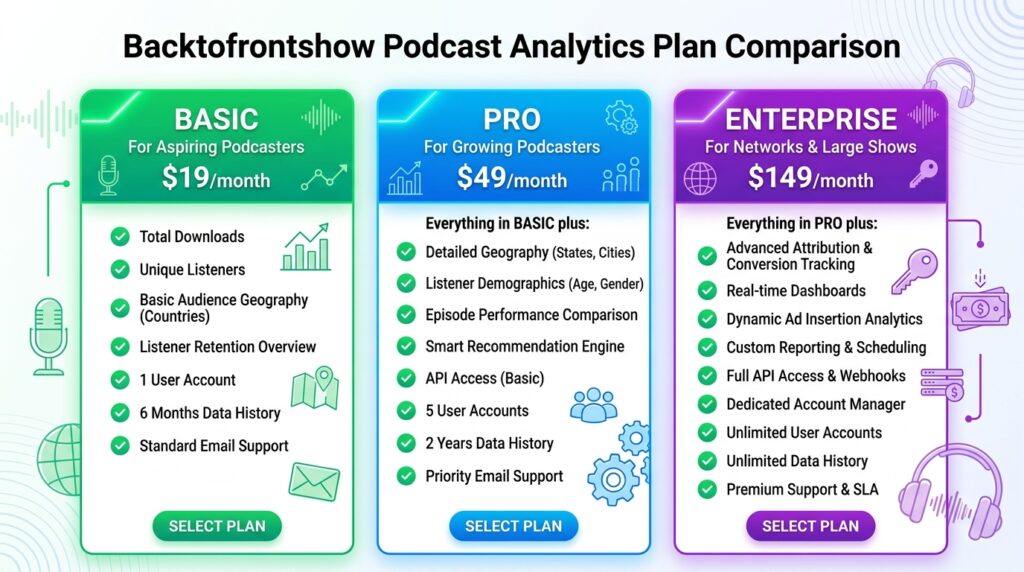
The platform publishes three clear tiers on its official pricing page. Here is the straightforward overview:
| Plan | Monthly Price | Approximate 12-Month Cost | Best Fit |
|---|---|---|---|
| Basic | $1,200 | $14,400 | Teams needing core audience and engagement analytics |
| Pro | $3,600 | $43,200 | Media teams or networks requiring behavior tracking, sentiment tools, and integrations |
| Enterprise | Custom (contact for quote) | Varies | Larger organizations needing geographic depth, custom reports, dedicated support, and advanced options |
These figures come directly from the published monthly rates. No separate annual discount appears on the public page, so the yearly numbers are simple multiplications. The jump from Basic to Pro equals $2,400 more each month, or roughly $28,800 over a full year. That gap is the most important number to evaluate against the added capabilities.
Basic Plan: Core Analytics for $1,200 Per Month
The Basic plan serves as the entry point. At $1,200 monthly it already positions itself for professional use rather than individual creators testing the waters.
Key features include:
- Listener demographics tracking (age and location insights)
- Playback location analysis
- User engagement monitoring (likes, shares, comments, and social interaction metrics)
- 24/7 customer support
- Data security measures
Think of this tier as a solid foundation for understanding who is tuning in and how they interact at a surface level. A small media team running one or two shows can use the demographic and engagement data to refine episode topics or adjust promotion channels. For example, spotting that a large share of listeners cluster in a particular city can guide local sponsorship outreach or targeted social ads.
What it does not include becomes equally important. Listening behavior details such as average listen time or episode drop-off points stay limited or absent. Device analytics, AI sentiment tools, real-time updates, and API access sit higher in the lineup. Support remains available around the clock, yet it operates through standard channels rather than dedicated account management.
This plan makes sense when your primary need is reliable core reporting without heavy customization or advanced behavioral layers. If your current tools already give you downloads and basic location data, the Basic tier may feel incremental rather than transformative. Still, the security and support features add practical value for teams handling sensitive audience information.
Pro Plan: Deeper Insights at $3,600 Per Month
The Pro plan triples the monthly investment and expands the feature set significantly. The $3,600 price reflects the addition of tools that turn raw data into actionable strategy.
Beyond everything in Basic, Pro adds:
- Listening behavior tracking (episode popularity trends and average listening time)
- Multi-platform device analytics (device preferences and optimization signals)
- AI-driven sentiment analysis (categorizing feedback as positive, negative, or neutral)
- Holistic feedback aggregation across platforms
- Real-time data updates
- API integration for connecting with external systems
These capabilities matter most when content decisions drive revenue. A podcast network managing multiple shows can use average listen time data to identify weak segments in episodes and tighten structure. Device analytics help prioritize production quality for the platforms where most listeners actually consume content. Sentiment analysis surfaces recurring themes in comments that numbers alone miss.
Real-time updates and API access further support teams that feed data into larger dashboards or marketing platforms. The practical impact appears in faster iteration cycles. Instead of waiting for weekly reports, operators can spot engagement shifts and adjust promotion or content plans within the same day.
The cost difference is substantial. Teams should calculate whether the extra $2,400 monthly produces measurable gains in retention, ad rates, or sponsorship value. For operations where audience intelligence directly influences monetization, the upgrade often justifies itself. For smaller shows still building consistent output, the jump can feel premature.
Enterprise Plan: Custom Pricing for Scaled Operations
Enterprise pricing requires a direct conversation with the company. No fixed public rate appears, which is standard for software serving organizations with varied data volumes, security needs, and integration requirements.
This tier includes all Pro features plus:
- Geographical analytics (mapping audience hotspots and regional trends)
- Custom reports tailored to specific needs
- Access to premium templates
- Priority feature requests
- Dedicated account manager
- White-labeling options
- Advanced user training
- Monthly analytics webinars
- Custom onboarding sessions
Large networks or agencies often need geographic depth to support regional advertising strategies or expansion planning. Custom reports and white-labeling become useful when data must fit internal systems or client deliverables. Dedicated support and training reduce the learning curve for bigger teams.
Because pricing stays custom, factors such as audience size, number of shows, integration complexity, and support expectations influence the final quote. Expect a sales discussion that explores these variables. This approach allows flexibility but also means buyers should prepare clear requirements and comparison points before contacting the team.
Hidden Costs and Practical Considerations
Public pricing focuses on the subscription tiers, yet several real-world factors can affect total cost of ownership.
No permanent free plan or public free trial appears on the official pages. Access begins with a request process for paid tiers. Some organizations may negotiate annual commitments or volume arrangements during sales conversations, though these details remain off the public site.
Integration work can add internal time or external consulting costs if your existing tools require custom API connections. Data volume or additional seats might influence Enterprise quotes. Optional workshops or specialized sessions sometimes appear in similar platforms, though none are listed as mandatory here.
Support quality and onboarding speed also carry indirect costs. Faster resolution of issues or clearer training can reduce the time your team spends troubleshooting, which has real budget impact over months. Always confirm current terms, any usage limits, and data retention policies directly with the provider before signing.
How Backtofrontshow Pricing Compares to Industry Alternatives
Podcast analytics tools range from free host-provided dashboards to premium intelligence platforms. Basic download and geographic data often come included with hosting services. More advanced behavioral and sentiment layers typically command higher fees.
Backtofrontshow sits in the premium segment. Its Basic plan already exceeds the monthly cost of many mid-tier analytics add-ons. The Pro tier aligns more closely with enterprise-grade solutions that emphasize real-time insights and integrations. Competitors may offer lower entry points with usage-based scaling or annual discounts, while others focus on advertising verification rather than behavioral depth.
The value assessment depends on your current baseline. If free or low-cost tools already deliver the demographics and engagement metrics you need, the jump to $1,200 or $3,600 monthly requires clear evidence of incremental results. When audience insights directly improve ad rates, sponsorship packages, or content retention, the higher investment can deliver measurable return. Agency owners managing multiple client shows often find the multi-show visibility and reporting features particularly useful for client reporting.
Digital marketers and website teams using podcasts as part of broader campaigns can evaluate the platform against tools that feed data into CRM or advertising systems. The API access in higher tiers supports those workflows.
Is Backtofrontshow Worth the Price?
The honest answer varies by operation size and goals. For independent creators or very small teams, the entry price may exceed the practical benefit of the available insights. Professional media companies, podcast networks, and agencies that treat audience data as a core decision tool are the clearer fit.
Consider these practical checkpoints:
- Does your current analytics leave important questions unanswered about listen-through rates, device preferences, or sentiment?
- Would deeper data change content strategy, monetization approach, or promotion spend enough to cover the monthly fee?
- Can your team actually act on the insights, or will the dashboards simply sit unused?
A useful exercise is to list the three most important unanswered questions about your audience. Then match those questions against the feature lists above. If Basic covers them, start there. If behavior, sentiment, and integrations appear critical, evaluate Pro carefully. Larger organizations should request an Enterprise conversation with specific use cases ready.
Value also compounds over time. Consistent use of behavioral data often improves episode structure and audience retention, which in turn supports higher advertising rates. The platform’s reported user satisfaction figures and focus on precision analytics suggest it delivers for teams that integrate the insights into regular workflows.
Next Steps for Evaluating the Platform
- Review your current analytics stack and identify the biggest gaps in audience understanding.
- Calculate the realistic monthly budget available for specialized tools.
- Request access or a demo through the official site to confirm current features and any temporary offers.
- Prepare questions about data volume limits, integration requirements, and support response times.
- Compare the projected return against the monthly investment using conservative estimates of improved engagement or monetization.
Share your experience with similar tools in the comments if you have tested comparable platforms. Real-world feedback from digital marketers and agency owners helps everyone refine their evaluation process.
Frequently Asked Questions
How much does Backtofrontshow cost per month?
The published Basic plan is $1,200 per month. The Pro plan is $3,600 per month. Enterprise pricing requires a custom quote.
What is the cheapest Backtofrontshow plan?
Basic is the lowest publicly listed option at $1,200 monthly.
Is there a free trial or free plan for Backtofrontshow?
No permanent free plan or public free trial appears on the official pricing page. Access starts through a request process for the paid tiers.
What features does the Pro plan add over Basic?
Pro includes listening behavior tracking, multi-platform device analytics, AI-driven sentiment analysis, feedback aggregation, real-time data updates, and API integration.
Who is Backtofrontshow best suited for?
Professional podcasters, media teams, podcast networks, and agencies that need deeper audience intelligence beyond basic download counts.
Does Backtofrontshow offer annual discounts?
The public page lists monthly rates only. Any annual pricing or volume arrangements would need confirmation during a sales conversation.
How does Enterprise pricing work?
Enterprise has no fixed public price. Interested organizations contact the company for a quote based on specific requirements such as data volume, custom reporting, and support needs.
You May Also Like: What is Frehf? The Ultimate Guide to the Human-Centered Decision Framework