
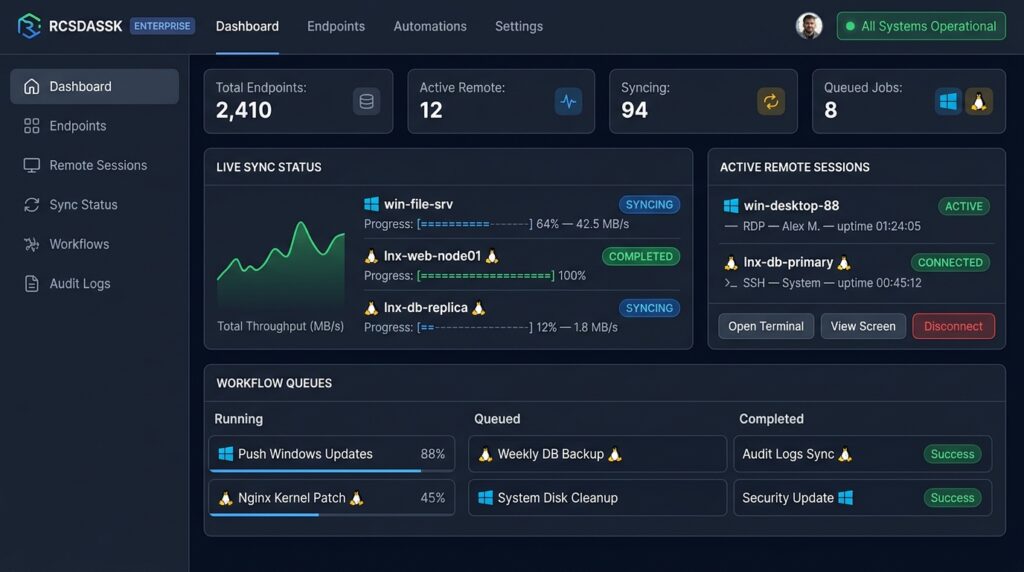

Picture this: your IT team juggles five different tools just to keep remote devices configured, data synced, and workflows moving. Now imagine one platform that ties Remote Configuration Services (RCS) to a Data Access System Software Kernel (DASSK), cutting tool sprawl and friction in a single stroke. That is the promise behind the new software rcsdassk, a modular suite built for IT professionals, sysadmins, and operations leaders who need real control without the chaos.
In this guide, you will learn what RCSDASSK is, how its architecture works, which features matter most in production, and exactly how to install and troubleshoot it on Windows and Linux. You will also see how it stacks up against traditional stacks and get quick fixes for common initialization errors.
What Is RCSDASSK and Why It Matters Now
RCSDASSK is an enterprise productivity suite that unifies remote configuration, data access, automation, and analytics under one roof. In plain terms, it lets you manage devices and services remotely while ensuring data flows reliably between cloud, servers, and endpoints.
The name reflects its core pillars: Remote Configuration Service (RCS) for device and service orchestration, and Data Access System Software Kernel (DASSK) for structured, secure data movement and query handling. By binding these together, the platform reduces the number of point tools teams must maintain and speeds up time to insight.
For organizations battling tool sprawl, RCSDASSK offers a single pane of glass for operational task management, cloud‑to‑client synchronization, and real‑time analytics. That consolidation is why it has gained traction among tech leads and business operations directors in 2025–2026.
Architecture at a Glance: How RCSDASSK Is Built
RCSDASSK uses a modular, plugin‑driven architecture that separates core services from optional extensions. This design keeps the base install lean while allowing teams to add capabilities such as advanced reporting, custom APIs, or domain‑specific connectors.
At a high level, the stack includes:
- Core Kernel (DASSK): Handles data modeling, access control, caching, and query routing across local and remote stores.
- Remote Configuration Service (RCS): Manages device profiles, policy distribution, and secure remote sessions.
- Automation Engine: Orchestrates workflows, scheduled jobs, and event‑driven actions with low‑code templates.
- Analytics Pipeline: Streams telemetry into dashboards and supports AI‑driven insights for predictive maintenance.
- Security Layer: Enforces end‑to‑end encryption, MFA, and role‑based access control (RBAC).
- Integration Framework: Connects to common business apps and storage backends such as Google Drive, OneDrive, Salesforce, SAP, and Microsoft 365.
RCSDASSK architectural layers and responsibilities
| Layer | Responsibility | Typical Use Case |
|---|---|---|
| Core Kernel (DASSK) | Data models, access, caching, query routing | Unified data access across services |
| Remote Config (RCS) | Device profiles, policies, remote sessions | Fleet configuration and support |
| Automation | Workflows, schedulers, triggers | Routine ops and incident response |
| Analytics | Telemetry, dashboards, ML insights | Performance monitoring and forecasting |
| Security | Encryption, MFA, RBAC | Compliance and least‑privilege access |
| Integrations | Connectors to SaaS and storage | End‑to‑end workflow automation |
This separation of concerns means you can scale components independently and avoid bloating the main package. For example, a team might deploy the core kernel and RCS first, then add analytics plugins once baseline stability is proven.
Core Features That Drive Real Productivity
RCSDASSK blends remote access, automation, analytics, and security into one interface. Below are the capabilities that matter most in day‑to‑day operations.
- Remote System Access: Securely control computers, servers, or devices from anywhere, with session logging and policy enforcement.
- Automated Data Syncing: Real‑time synchronization across devices and platforms, reducing manual copy‑paste and version drift.
- Advanced Security Protocols: Built‑in firewall management, endpoint protection, and multi‑factor authentication to harden access.
- Modular Architecture: Add or remove features via plugins based on team needs, keeping the footprint right‑sized.
- Customizable Dashboard: Personalize widgets and real‑time monitoring views so critical metrics are always visible.
- Cross‑Platform Compatibility: Runs on Windows, Linux, macOS, and supports mobile clients for on‑the‑go management.
- Collaboration Tools: Built‑in messaging, file sharing, and task management to keep teams aligned inside the same workspace.
- AI‑Driven Insights: Machine learning models analyze performance trends and flag risks before they become outages.
For operations managers, the combination of workflow automation and real‑time analytics is the real win. Instead of stitching together separate RMM, EDR, and BI tools, RCSDASSK centralizes operational task management and reporting.
Installation Guide: How to Install New Software RCSDASSK
Below is a practical, step‑by‑step setup for Windows and Linux. The process is straightforward, but attention to prerequisites and permissions will save you time later.
Prerequisites and System Requirements
Before you begin, confirm your environment meets minimum specs and dependencies.
- Hardware: At least 4 GB RAM, dual‑core CPU, and 500 MB free storage. For heavier analytics workloads, plan for more RAM and CPU.
- Operating Systems: Windows 10/11, macOS 10.14+, or major Linux distributions (Ubuntu 18.04+, CentOS 7+, Debian 10+).
- Dependencies (optional scripting/extensions): Java 11 and Python 3.8 if you plan to use scripting extensions or custom plugins.
- Network: Stable internet connection for cloud sync and license activation; outbound HTTPS access to RCSDASSK services.
Windows Setup (GUI Installer)
- Download the installer: Visit the official RCSDASSK website and navigate to the Downloads section. Choose the Windows version that matches your license.
- Run the installer: Double‑click the setup file and follow the on‑screen prompts. Select your installation directory and startup preferences.
- Configure initial parameters: During setup, set cloud synchronization options and default connection parameters.
- Launch and sign in: Open RCSDASSK, sign in or create an account, and verify your email if required.
- Create your workspace: Name your first project, invite team members via email or a shareable link, and set default permission levels.
- Install apps and integrations: Download desktop and mobile apps from the downloads page, then connect storage integrations like Google Drive or OneDrive.
- Enable security: Set a strong admin password, enable MFA, and configure SSL for secure communications.
Linux Setup (CLI‑Friendly)
- Download the package: Fetch the latest stable release from the official RCSDASSK download page.
- Install dependencies: Ensure Java 11 and Python 3.8 are installed if you will use scripting extensions.
- Run the installer with privileges: Execute the installer as root or with sudo, choosing a directory with write permissions.
- Complete the wizard: Finish the installation steps and note the service name for systemd management.
- Launch the plugin manager: From the dashboard or CLI, open the plugin manager to install core extensions your team needs.
- Restart services: Restart the RCSDASSK server to apply new modules and confirm they load cleanly.
- Harden the setup: Set a strong admin password, enable MFA, and configure SSL certificates for encrypted traffic.
Tip: Keep a short checklist of your chosen directories, service names, and admin credentials in a secure password manager. This small habit prevents headaches during audits or team handovers.
First‑Time Configuration: Getting From Installed to Operational
Once installed, a few configuration steps turn RCSDASSK from “running” to “ready for production.”
- Enable cloud sync: Turn on cloud synchronization so devices and users stay in sync across locations.
- Set preferences: Define default regions, time zones, and data retention policies that match your compliance needs.
- Create user accounts and roles: Add team members and assign role‑based access levels to enforce least privilege.
- Connect integrations: Link storage and business apps (for example, Google Drive, OneDrive, Salesforce, SAP, Microsoft 365) to automate end‑to‑end workflows.
- Build your dashboard: Add widgets for key metrics such as sync status, active sessions, job queues, and error rates.
For teams adopting real‑time collaboration, enable co‑editing, comments, and threaded discussions inside workspaces. This keeps context attached to tasks instead of scattered across chat threads.
Troubleshooting: Fixing Software RCSDASSK Initialization Error
Initialization errors usually stem from permissions, missing dependencies, or network blocks. Here is a focused checklist to resolve them quickly.
- Run as administrator or with sudo: On Windows, right‑click the installer or app and select “Run as administrator.” On Linux, use sudo for service commands.
- Verify dependencies: Confirm Java 11 and Python 3.8 are installed and on the PATH if you use scripting extensions.
- Check write permissions: Ensure the installation directory and config folders are writable by the RCSDASSK service user.
- Inspect logs: Open the application or system logs to identify specific failure codes during startup.
- Validate network access: Confirm outbound HTTPS is allowed to RCSDASSK services and that firewalls or proxies are not blocking traffic.
- Restart services: After changes, restart the RCSDASSK server or app to apply new modules and settings.
- Reinstall cleanly: If problems persist, uninstall, delete residual config folders, and reinstall from the latest stable release.
If you see repeated initialization failures after a clean install, capture the exact error message and timestamp, then consult the official troubleshooting page or support channel with those details.
RCSDASSK vs Traditional Tech Stack: Where It Wins
Traditional stacks often rely on separate tools for remote management, data sync, automation, and analytics. RCSDASSK consolidates these layers, reducing integration debt and operational overhead.
RCSDASSK compared to a traditional multi‑tool stack
| Dimension | Traditional Stack | RCSDASSK |
|---|---|---|
| Tool count | Multiple point solutions (RMM, EDR, BI, iPaaS) | Single integrated suite |
| Data friction | Manual exports, siloed dashboards | Unified data kernel with real‑time sync |
| Automation | Script-heavy, fragmented triggers | Low‑code workflows and event drivers |
| Security | Varied policies per tool | Centralized MFA, RBAC, encryption |
| Analytics | Separate BI platform | Built‑in telemetry and AI insights |
| Maintenance | Higher overhead, more vendors | Modular plugins, single vendor footprint |
For mid‑size teams especially, the reduction in vendor management and the clarity of a single dashboard can free up significant engineering time.
Real‑World Setup Scenarios: From Pilot to Production
Consider a regional operations team rolling out RCSDASSK across three offices. They start with a pilot in one location, deploy the core kernel and RCS, and connect storage integrations. After two weeks, they add the analytics plugin and customize dashboards for each department.
Another common pattern is a help desk that uses remote sessions and automated data syncing to resolve tickets faster. By standardizing policies in RCS and automating routine fixes, they cut mean time to resolution and reduce escalations.
In both cases, the modular approach lets teams expand capability without re‑architecting the entire stack. That flexibility is why RCSDASSK fits well in environments that value incremental, low‑risk upgrades.
Security and Compliance: What Admins Need to Know
Security is baked into RCSDASSK through end‑to‑end encryption, two‑factor authentication, and role‑based access controls. These features help protect sensitive data while supporting compliance requirements.
Administrators should:
- Enforce MFA for all users, especially those with elevated privileges.
- Define granular roles so users only access what they need.
- Enable session logging for remote access to support audits.
- Configure SSL for all client‑server communications.
- Review and rotate admin credentials periodically.
For regulated industries, pair these controls with clear data retention policies and regular access reviews.
Performance Tips and Best Practices
To keep RCSDASSK running smoothly, follow these practical tips:
- Right‑size plugins: Install only the extensions your team actually uses to reduce memory and CPU load.
- Monitor resource usage: Use built‑in dashboards to track RAM, CPU, and disk I/O during peak hours.
- Schedule heavy jobs off‑peak: Run large syncs or analytics batches during low‑usage windows.
- Keep versions current: Apply stable updates regularly to benefit from performance and security improvements.
- Document configs: Maintain a living runbook with service names, ports, and dependency versions for faster troubleshooting.
These habits help prevent bottlenecks and make scaling predictable as your user base grows.
3 Actionable Tips to Try Today
- Start small, then expand: Deploy the core kernel and RCS first, validate stability, and add analytics or automation plugins in phases.
- Lock down access early: Enable MFA, set strong admin passwords, and define RBAC roles before onboarding many users.
- Build a minimal dashboard: Add three to five key widgets (sync status, active sessions, job queue, error rate) to gain immediate visibility.
FAQs
What does RCSDASSK stand for?
RCSDASSK refers to the combination of Remote Configuration Service (RCS) and Data Access System Software Kernel (DASSK), unified in one platform.
Is RCSDASSK safe to install?
When downloaded from the official RCSDASSK website and configured with MFA and SSL, it follows standard enterprise security practices. Always verify the source and keep the software updated.
Which operating systems are supported?
RCSDASSK supports Windows 10/11, macOS 10.14+, and major Linux distributions including Ubuntu 18.04+, CentOS 7+, and Debian 10+.
Do I need Java or Python to run RCSDASSK?
The core platform does not require them, but Java 11 and Python 3.8 are needed if you use scripting extensions or custom plugins.
How do I fix an initialization error on startup?
Run the installer or app as administrator (or with sudo), verify dependencies, check write permissions, inspect logs, validate network access, and restart services. If needed, reinstall from the latest stable release.
Can RCSDASSK integrate with tools like Salesforce or Microsoft 365?
Yes. The integration framework connects to over 200 business applications, including Salesforce, SAP, and Microsoft 365, enabling end‑to‑end workflow automation.
How does RCSDASSK handle real‑time collaboration?
It supports real‑time editing, version history, co‑editing, comments, and threaded discussions within workspaces, alongside cloud sync for consistent data across devices.
You May Also Like: What Is Awius? A Practical Guide to This New Marketing Platform