
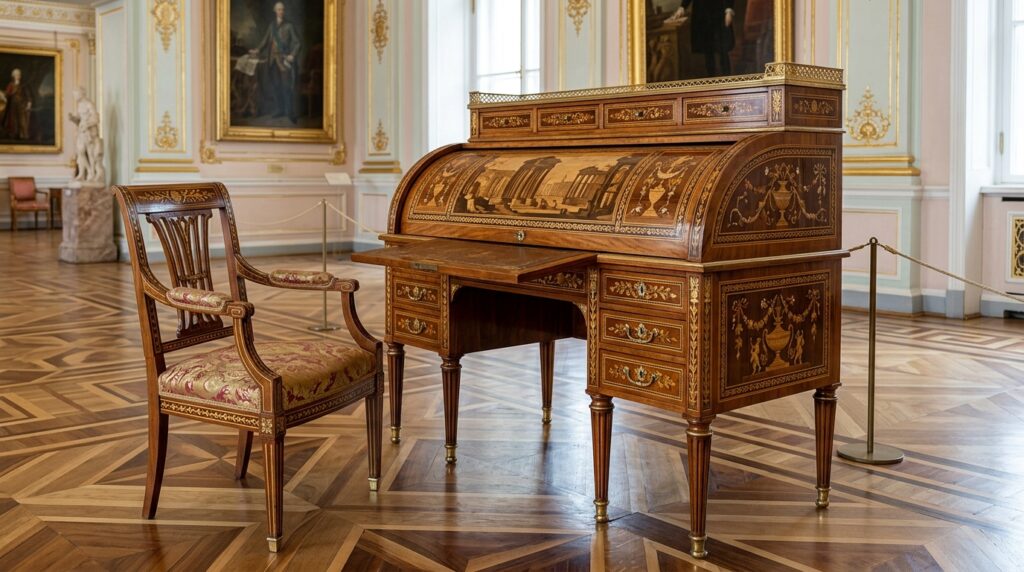

What if the most famous piece of furniture linked to Catherine the Great never actually existed? For centuries, whispers of an “erotic cabinet” filled with phallic tables and risqué chairs have clung to her name. Yet the real story of Catherine the Great furniture is far richer, more inventive, and far more revealing about power, taste, and empire than any salacious legend.
Catherine II, who ruled Russia from 1762 to 1796, turned furniture into a statement of imperial ambition. She filled the Winter Palace, the Hermitage, and her country residences with works that blended French elegance, German mechanical ingenuity, and emerging Russian craftsmanship. Today those pieces form a cornerstone of Russian Imperial decorative arts and still sit in the Hermitage Museum and other former imperial sites. This article explores the authentic collection, the craftsmen who made it, and the stubborn myths that continue to overshadow it.
The Empress Who Collected Like a Connoisseur and Ruled Like a Strategist
Catherine did not simply buy furniture. She used it. In an age when European courts measured status by the quality of their interiors, she understood that mahogany desks and gilt-bronze mounts could announce that Russia belonged among the great powers. Early in her reign the palace rooms still showed the swirling curves of Rococo. By the 1780s a cooler, more ordered Neoclassical style dominated. Straight lines, classical motifs, and the warm glow of exotic woods replaced playful asymmetry.
She imported the best. German cabinetmaker David Roentgen became her most important supplier of mechanical furniture. Russian workshops in St. Petersburg, including those run by Christian Meyer and Heinrich Gambs, produced high-quality pieces that matched European standards. Marquetry panels of ivory, Karelian birch, and tropical woods appeared on commodes and tables. Ormolu mounts, finely chased and gilded, added the final imperial flourish. The result was a distinctive Russian Imperial style that mixed French fashion, German precision, and local materials.
Much of this furniture was intended for the private apartments of the Winter Palace and for the Hermitage buildings Catherine added beside it. These were not merely decorative. They created settings for intellectual conversation, private study, and the quiet display of power.
David Roentgen and the Magic of Mechanical Furniture
No name is more closely tied to Catherine the Great furniture than David Roentgen. Working from Neuwied in Germany, Roentgen specialized in “surprise” furniture: desks, tables, and cabinets whose drawers, panels, and writing surfaces moved at the touch of a hidden spring or the turn of a key. In the 1780s he made repeated visits to St. Petersburg and shipped hundreds of pieces to the Russian court.
One of the most celebrated is the Apollo desk of 1783–84. Roentgen designed it with Catherine’s tastes in mind. A figure of Apollo stands atop a classical mountain, flanked by the Muses. A small bronze dog, modeled after one of the Empress’s favorite pets, serves as a secret release. Press it and panels slide, compartments open, and the desk reveals its hidden architecture. Catherine paid a fortune for the piece (roughly the price of a country estate) and immediately ordered more. Later shipments included writing tables that transformed into dressing tables, music stands that disappeared into the frame, and cabinets fitted with clocks and mechanical figures.
These were not toys. They were statements of Enlightenment ingenuity. A Roentgen desk let its owner control information and privacy. Drawers could hide correspondence. Mechanisms could startle guests or simply delight them. In the Hermitage today, surviving examples still demonstrate the same precise engineering that astonished eighteenth-century viewers.
Russian makers quickly absorbed the lessons. Christian Meyer produced elegant games tables and corner cabinets with intricate marquetry for the Winter Palace. Heinrich Gambs supplied mahogany display cases and seating that combined classical restraint with Russian materials. The result was a flourishing of Russian Imperial decorative arts that outlasted Catherine’s reign and helped define the Romanov court style for decades.
Rococo Beginnings and Neoclassical Maturity
Catherine’s early furniture still carried Rococo energy. A pair of imperial commodes from around 1762–65, one of which remains in the Hermitage, shows bombe curves, trellis marquetry in ivory and exotic woods, and silver mounts bearing the Empress’s cypher and the arms of Siberia. These pieces were almost certainly made for her personal use at Peterhof or the Winter Palace.
By the mid-1780s the mood had changed. Neoclassical furniture favored symmetry, fluted legs, geometric inlays, and motifs drawn from ancient Greece and Rome: urns, laurel wreaths, sphinxes, and classical figures. Mahogany became the preferred wood. Gilt-bronze mounts grew more architectural. The shift mirrored Catherine’s own self-image as an enlightened ruler who admired classical antiquity and wanted her court to reflect reason and order.
Winter Palace interiors under her direction mixed both styles. Private rooms retained some of the earlier softness, while public and semi-public spaces moved toward the cooler clarity of Neoclassicism. Architects such as Charles Cameron and Yury Felten designed rooms that framed the furniture perfectly, creating coherent ensembles of walls, floors, and movable pieces.
The Erotic Cabinet Myth: Separating Legend from Evidence
No discussion of Catherine the Great furniture is complete without the notorious “erotic cabinet.” According to the story, the Empress kept a secret room, often placed at Gatchina or Tsarskoye Selo, filled with furniture carved in the shape of sexual organs, tables with phallic legs, and walls covered in explicit art. Some versions claim the room was discovered by German soldiers during the Second World War and photographed before the palace was damaged.
Historians have searched for proof and found none that holds up. No eighteenth-century inventory mentions such pieces. No contemporary letter or memoir describes them. The alleged photographs that circulate online cannot be firmly linked to any verified wartime report. The timeline in many versions is wrong: some place the discovery in 1940, yet the German invasion of the Soviet Union began in June 1941. Style experts have also noted that the objects in the photographs look more like late-nineteenth-century work than anything from Catherine’s era.
The myth fits a larger pattern. Powerful women in history have often been attacked through stories about uncontrolled sexuality. Catherine had a documented private life that included several long-term relationships. That reality was enough for political enemies and later gossip-mongers to invent more extreme tales, including the famous (and equally false) story of her death involving a horse. The erotic furniture legend belongs to the same family of propaganda. It is vivid, memorable, and almost certainly invented.
What did exist was a Romanov-era collection of erotic art and objects, some of which were catalogued in the early twentieth century and later lost or destroyed. Whether any of those pieces dated to Catherine’s time remains unproven. The Hermitage holds no authenticated erotic furniture from her reign. The authentic Catherine the Great furniture that survives is mechanical, classical, and imperial, not pornographic.
Where the Real Collection Lives Today
Much of Catherine’s furniture still resides in the State Hermitage Museum in St. Petersburg. The Winter Palace rooms preserve original and restored pieces. Other examples can be found at Tsarskoye Selo, Peterhof, and Pavlovsk. Occasional pieces appear at auction, often with clear provenance linking them to imperial inventories. A pair of games tables by Christian Meyer, delivered to Catherine’s private apartments around 1795–97, sold at Christie’s after research confirmed their history. Commodes bearing her cypher have also come to market and drawn serious interest from collectors of Russian Imperial decorative arts.
For visitors, the Hermitage remains the best place to see the work in context. Walking through the rooms once used by Catherine allows a direct encounter with the craftsmanship: the precision of Roentgen’s mechanisms, the subtle glow of marquetry, the cool authority of Neoclassical forms. These objects were never mere decoration. They were tools of statecraft and personal expression.
Why the Collection Still Matters
Catherine the Great furniture offers more than beauty. It shows how an ambitious ruler used the decorative arts to reshape her country’s image. It records the transfer of technical knowledge from German and French workshops into Russian hands. It demonstrates the shift from Rococo playfulness to Neoclassical order that defined late-eighteenth-century Europe. And it reminds us how easily historical women can be reduced to sexual caricature.
Collectors and design historians continue to study these pieces for their technical brilliance and cultural meaning. Interior designers still draw inspiration from the clean lines and rich materials of the later imperial style. And general readers keep returning to the subject because the combination of genuine mastery and persistent myth is irresistible.
Key Takeaways
- Catherine’s authentic furniture collection centers on high-quality European and Russian work in Rococo and especially Neoclassical styles.
- David Roentgen’s mechanical desks and tables represent the peak of technical innovation commissioned by the Empress.
- Russian makers such as Christian Meyer and Heinrich Gambs produced refined pieces that matched international standards.
- The “erotic cabinet” story lacks solid documentary or physical evidence and fits a long pattern of sexualized attacks on powerful women.
- Surviving examples remain on view in the Hermitage and other former imperial residences, offering direct access to the real legacy.
If you visit St. Petersburg, make time for the Hermitage’s furniture galleries and the reconstructed imperial rooms. Look closely at the mechanisms, the marquetry, and the proportion. You will see the true face of Catherine the Great furniture: intelligent, ambitious, and built to last.
Share your own thoughts or questions about imperial design in the comments. What other royal collections have you found equally fascinating?
FAQs
What is the most famous piece of Catherine the Great furniture?
The Apollo desk by David Roentgen is among the best known. It combines classical sculpture, secret compartments, and mechanical ingenuity and was commissioned specifically with the Empress’s tastes in mind.
Did Catherine the Great really own erotic furniture?
No verified evidence supports the existence of an erotic cabinet or sexually explicit furniture from her reign. The story appears to be a later legend.
Where can I see authentic Catherine the Great furniture today?
The largest holdings are in the State Hermitage Museum in St. Petersburg. Additional pieces remain at Tsarskoye Selo, Peterhof, and other former imperial sites.
Who made the mechanical furniture for Catherine the Great?
David Roentgen of Neuwied, Germany, was her principal supplier of complex mechanical desks and tables. Russian workshops also produced high-quality work under imperial patronage.
What styles dominate Catherine the Great’s furniture collection?
Early pieces show Rococo curves and playful ornament. From the 1780s onward, Neoclassical symmetry, classical motifs, and fine mahogany dominate.
Are any original pieces still in private hands?
Yes. Occasional items with strong provenance appear at major auction houses, including games tables and cabinets linked to the Winter Palace inventories.
Why do the erotic furniture myths persist?
They fit a long historical pattern of attacking female rulers through stories of sexual excess. The combination of Catherine’s real private life and later wartime rumors kept the legend alive despite the lack of solid proof.
You May Also Like: What Types of Custom Luxury Closets Can Austin Homeowners Choose From?