
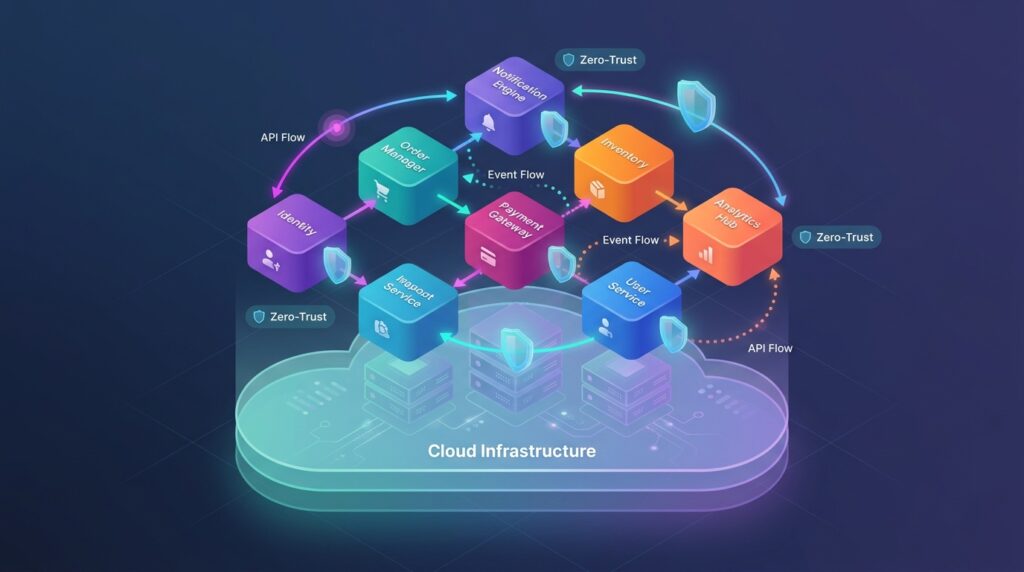

Picture this: your company’s core systems still talk to each other like strangers at a formal dinner, polite but slow and full of rigid rules. Every new feature feels like rearranging the entire room. Now imagine those same systems as skilled specialists who know exactly when to step in, share just the right information, and get back to their own work without drama. That shift is what people mean when they talk about SOA OS23.
SOA OS23 (Service-Oriented Architecture Open Standard 2023) is the practical, cloud-native update to classic service-oriented ideas. It keeps the best parts of traditional SOA (clear boundaries, reusable services, business alignment) while dropping the heavy Enterprise Service Bus and SOAP baggage that slowed teams down. Instead it leans on lightweight APIs, containers, event streams, and modern security practices so services can evolve independently yet still work together reliably.
This guide walks through what SOA OS23 actually is, how the layers fit together, the principles that keep it sane, how it compares with pure microservices and older SOA, the real benefits, and practical steps for moving legacy systems toward it. Whether you are an architect planning a modernization, a DevOps engineer dealing with integration pain, a student studying service design under a course code that references OS23, or even someone who stumbled here from the Italian construction certification world (more on that later), the goal is the same: give you a clear, usable picture.
Understanding SOA OS23 in Plain Terms
At its heart, SOA OS23 treats every meaningful business capability as an independently deployable service. Each service owns its logic and data, exposes a well-defined contract (usually OpenAPI or AsyncAPI), and communicates through standard protocols such as REST, gRPC, or asynchronous events. You can run those services on virtual machines, containers, or serverless platforms. Governance stays decentralized but not chaotic: schema registries, clear versioning, and service discovery keep everyone honest.
Think of it as domain-driven design meeting operational reality. Services are not tiny “micro” fragments that create operational overload, nor are they the large, coarse-grained services of early SOA that were hard to change. They sit in a practical middle ground, often called macroservices or bounded-context services. The result is organizational alignment (teams can own clear business capabilities) plus the deployment speed teams expect from modern cloud platforms.
The “OS23” part signals the 2023-era standards and practices: API-first design, zero-trust security by default, observability built in from day one, and readiness for AI-assisted orchestration. It is not a single product or proprietary platform. It is a shared architectural approach that many organizations now use as their reference model when they modernize.
Key Principles of SOA OS23 Design
Several principles keep SOA OS23 systems healthy over time.
Loose coupling is non-negotiable. Services know as little as possible about each other’s internal details. They depend only on published contracts. When one team changes its database schema or language, the rest of the system should not break.
Service discoverability replaces hard-coded endpoints. A registry or service mesh lets consumers find current locations and versions at runtime. This supports dynamic scaling and blue-green or canary deployments without manual reconfiguration.
Component reusability remains a core goal, but it is realistic rather than absolute. A well-designed authentication or notification service can be shared across multiple products. Over-sharing, however, creates unwanted coupling, so teams balance reuse against independence.
Standardized contracts come first. Teams define OpenAPI or AsyncAPI specifications before writing much code. Contract tests and schema validation in the CI pipeline catch breaking changes early.
Private data ownership means each service manages its own storage. Shared databases are avoided because they quietly reintroduce tight coupling. When data must be shared, events or carefully designed APIs carry the information.
Zero trust security assumes no internal network is safe. Every request is authenticated and authorized, often with short-lived tokens and mutual TLS. Policy enforcement happens at the API gateway or service mesh layer rather than relying on a trusted perimeter.
These principles work together. Follow them and you get systems that can scale individual capabilities, survive partial failures, and absorb new technology without a full rewrite.
SOA OS23 Architectural Layers Explained
Most SOA OS23 implementations organize responsibility into clear layers so teams know where concerns belong.
The presentation and experience layer handles user interfaces, mobile apps, and external partner portals. It talks only to an API gateway or backend-for-frontend services rather than reaching deep into business logic.
The API gateway and edge layer manages routing, rate limiting, authentication, and request transformation. It is the controlled front door. Modern gateways also handle protocol translation and can enforce zero-trust policies.
The business service layer contains the core domain services. Each service implements one or more related business capabilities (order management, inventory, pricing, customer profile) and owns its data store. These services are the heart of the architecture.
The integration and event layer handles asynchronous communication, message brokers, and event streams. Many workflows that used to require complex orchestration now happen through published events. Services react to what happened rather than calling each other in long synchronous chains.
The infrastructure and platform layer provides containers, orchestration (usually Kubernetes), service mesh, observability tooling, and the underlying cloud or hybrid resources. This layer is deliberately technology-agnostic so teams can choose the right runtime for each service.
Data consistency across services is managed through patterns such as eventual consistency, sagas, or outbox patterns rather than distributed transactions. Observability (logs, metrics, distributed traces) cuts across every layer so operators can understand system behavior end to end.
SOA OS23 vs Traditional Microservices and Classic SOA
It helps to place SOA OS23 next to the two approaches people most often compare it with.
Classic SOA (roughly 2000s–early 2010s) relied heavily on centralized Enterprise Service Buses, SOAP/XML, and WSDL contracts. Governance was strong but heavy. Change was slow because the bus became a bottleneck and a single point of failure. Reuse was theoretically high, yet teams often struggled with the complexity and cost of the middleware.
Pure microservices architectures went the opposite direction: very fine-grained services, independent teams, and maximum autonomy. The downside is operational complexity. Hundreds of tiny services create network chatter, versioning headaches, and distributed debugging challenges. Many organizations discovered they had traded development speed for operational pain.
SOA OS23 sits between them. It keeps the business-capability focus and explicit contracts of classic SOA while adopting the independent deployment, container-native packaging, and decentralized data of microservices. Communication is mostly lightweight (REST, gRPC, events) rather than heavyweight SOAP. Governance exists but is lighter: schema registries and automated contract testing instead of a central bus that every message must pass through. The result is usually medium-sized services aligned to domains, with clearer ownership and less accidental complexity.
Benefits of Implementing SOA OS23
Organizations that adopt the approach thoughtfully tend to see several practical gains.
Independent scaling becomes straightforward. A payment service under heavy load can scale without touching the catalog or recommendation services. Teams ship changes to their own services on their own schedule, which shortens lead time for business features.
Technology diversity is easier to manage. One team can use Java and PostgreSQL while another uses Go and a document store, as long as the contracts stay stable. Legacy systems can be wrapped behind modern APIs and gradually replaced rather than rewritten in one painful project.
Resilience improves because failure is contained. Circuit breakers, retries, and bulkheads live at the service or mesh level. A problem in one area does not cascade as easily.
Security posture strengthens with zero-trust defaults and centralized policy points at the gateway and mesh. Auditing and compliance become more consistent because every interaction is observable and policy-enforced.
For students and architects studying the material, the principles map cleanly onto modern cloud-native and distributed systems courses. The same ideas appear in domain-driven design, event-driven architecture, and platform engineering discussions.
How to Transition Legacy Systems to SOA OS23
Most organizations do not start from a green field. A realistic path usually looks like this.
Begin with a clear domain model. Identify bounded contexts and the services that should own them. Avoid the temptation to split by technical layers alone.
Introduce an API gateway in front of existing systems. This gives you a place to enforce authentication, rate limits, and routing while the internal systems remain largely unchanged.
Extract one high-value capability at a time. Prefer services that already have relatively clean boundaries or that change frequently. Wrap the legacy code behind a new contract, move traffic gradually, then retire the old path.
Adopt asynchronous events early for cross-service communication. This reduces synchronous call chains and makes the system more resilient.
Invest in observability and contract testing from the first extraction. Without them, the distributed system becomes hard to operate and hard to change safely.
Governance can stay lightweight. A small architecture guild or platform team can own the shared standards (OpenAPI conventions, naming, security baselines) while product teams own their services.
Many teams start with a modular monolith that already respects domain boundaries, then extract services only when independent scaling or independent release cycles become necessary. That hybrid approach often delivers most of the benefits with less risk.
SOA OS23 Security and Governance Best Practices
Security in SOA OS23 starts with identity. Every service and every caller has a strong identity. Mutual TLS between services, short-lived tokens for human and machine callers, and fine-grained authorization decisions at the gateway or mesh are standard.
Schema and contract governance prevents the “it worked in staging” problem. Automated checks in the pipeline reject breaking changes. Semantic versioning and clear deprecation policies give consumers time to adapt.
Observability is treated as a first-class concern. Structured logging, metrics, and distributed tracing are required of every service. Centralized dashboards and alerting make it possible to understand system health without logging into dozens of systems.
For regulated environments, audit trails of policy decisions and data access become part of the platform rather than an afterthought.
A Note on the Other SOA OS23
If you arrived here from the Italian public works or construction world, you may be looking for something different. In that context SOA OS23 refers to a specialized qualification category (Opere Specializzate 23) under Italy’s SOA attestation system. It certifies companies for demolition works on public tenders above certain value thresholds. The two meanings share the same letters but live in completely separate domains. This article focuses on the software architecture meaning. Construction and procurement teams should consult the official ANAC guidance and authorized SOA bodies for the qualification requirements.
Quick Takeaways
SOA OS23 modernizes classic service orientation for cloud-native and event-driven environments.
Services own their data and expose stable contracts; communication stays lightweight.
Loose coupling, discoverability, and zero-trust security are built in rather than bolted on.
Migration works best when done incrementally behind an API gateway with strong observability.
The approach sits between the rigidity of old SOA and the operational chaos that pure microservices can create.
If you are evaluating or already implementing service architectures, the real test is whether your teams can change one capability without fear of breaking others and whether operators can understand the system when something goes wrong. SOA OS23 gives a practical set of principles and patterns that help teams reach that state.
What part of your current architecture feels most constrained right now? The data ownership model, the release process, or the security and governance overhead? Those pain points usually point to the first places where SOA OS23 ideas can deliver the most value.
FAQs
What is SOA OS23 in software engineering?
SOA OS23 stands for Service-Oriented Architecture Open Standard 2023. It is a modern architectural approach that organizes systems as independent, reusable services. Each service owns its logic and data, communicates through clear contracts (usually OpenAPI or AsyncAPI), and runs on cloud-native platforms. It updates classic SOA ideas with lightweight APIs, containers, event-driven patterns, and zero-trust security so teams can build flexible, scalable systems without the heavy middleware of the past.
How does SOA OS23 differ from traditional SOA and pure microservices?
Traditional SOA relied on centralized Enterprise Service Buses, SOAP, and rigid contracts, which made change slow. Pure microservices often create hundreds of tiny services that increase operational complexity. SOA OS23 sits in the middle. It keeps business-focused service boundaries and strong contracts while using independent deployment, private data ownership, REST/gRPC/events, and lighter governance. The result is medium-sized, domain-aligned services that are easier to scale and operate than either extreme.
What are the main benefits of implementing SOA OS23?
Teams gain the ability to scale and update individual services independently, reduce the risk of one change breaking the whole system, and adopt different technologies for different capabilities. Systems become more resilient through contained failures, stronger security with zero-trust practices, and clearer ownership. Organizations also find it easier to modernize legacy applications gradually rather than rewriting everything at once.
What are the key principles of SOA OS23 design?
The core principles include loose coupling (services know little about each other’s internals), standardized contracts defined before coding, private data ownership per service, service discoverability through registries or meshes, realistic component reusability, and zero-trust security on every request. These keep systems adaptable over time while preventing the tight dependencies that plague older architectures.
How can organizations transition legacy systems to SOA OS23?
Start by mapping business domains and introducing an API gateway in front of existing systems. Extract one high-value capability at a time, wrap legacy code behind modern contracts, and shift traffic gradually. Add asynchronous events early for cross-service communication, invest in observability and contract testing from the beginning, and keep governance lightweight. Many teams begin with a modular monolith that already respects domain boundaries before extracting full services.
How does SOA OS23 handle security and governance?
Security assumes no internal network is trusted. Every request is authenticated and authorized, often with mutual TLS and short-lived tokens. Policy enforcement happens at the API gateway or service mesh. Governance focuses on automated contract validation, schema registries, semantic versioning, and strong observability (logs, metrics, traces) so teams can change services safely and understand system behavior in production.
Is SOA OS23 related to the Italian construction demolition certification?
No. In software architecture, SOA OS23 refers to the modern service-oriented framework described above. In Italian public works, SOA OS23 is a specialized qualification category for demolition works under the national attestation system. The two share the same letters but apply to completely different fields. This article covers only the software architecture meaning.
You May Also Like: What Is Oncepik? Everything You Need to Know in 2026