
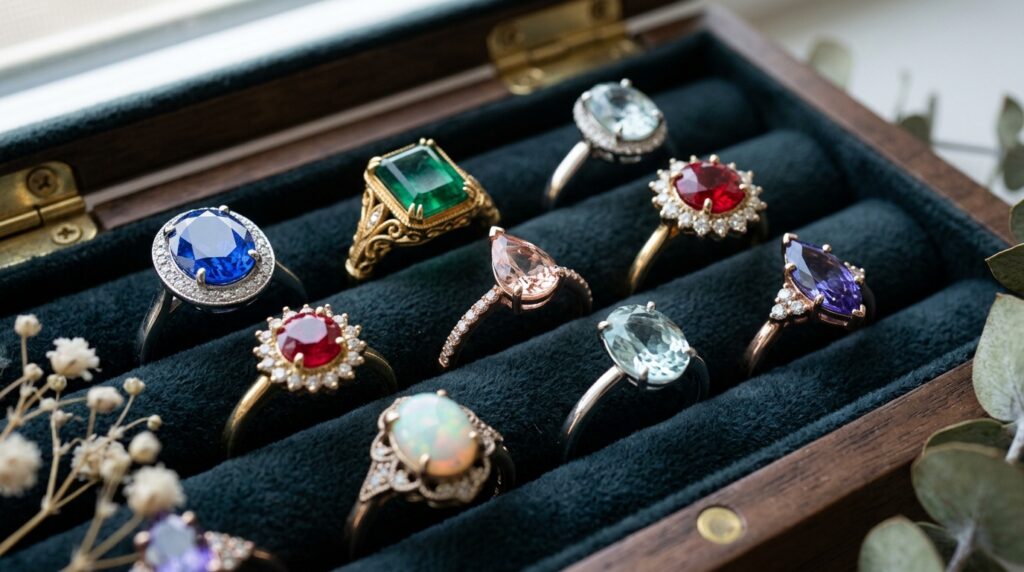

For most of the last century an engagement ring meant a diamond. That is no longer a given. Sapphires, emeralds, garnets and a long list of other stones now show up on left hands everywhere. A colored stone can carry personal meaning, cost far less than a diamond of the same size, and look like nothing else in the room. Here is what to know before choosing one.
Start with hardness
An engagement ring gets worn every day, so the stone has to survive dishes, door handles and gym bags. Hardness runs on the Mohs scale from 1 to 10, with diamond at the top. Anything 7 or above will hold up to daily wear with reasonable care. Below 7, the stone can scratch and dull over time and needs a protective setting or occasional wear.
Sapphire and ruby sit at 9. Spinel, topaz and aquamarine are around 8. Garnet, tourmaline and most quartz fall between 6.5 and 7.5. Emerald is close to 8 but is usually included, which makes it chip more easily than the number suggests. Opal, moonstone, pearl and tanzanite are soft enough that they are better as a right-hand ring.
The main contenders
Sapphire comes in every color except red. Classic blue is only the start; teal, peach, yellow and pale pink have all become popular for engagement rings. It is tough enough to be set any way you like. Strong, even color and untreated stones cost more.
Ruby is the same mineral as sapphire in red. Fine rubies are among the priciest gems on earth per carat, but smaller stones and slightly pinkish or purplish reds are far more reachable. Nearly all rubies are heat treated, which is standard.
Emerald has a green nothing else can match, but it is the hardest of the big three to live with. Nearly every emerald has visible inclusions and most are treated with oil or resin. Worn with a little awareness and cleaned gently, it will last. Well-made Emerald engagement rings use a bezel or a halo to give the stone some cover.
Spinel is the stone the trade keeps to itself. It comes in red, pink, grey, blue and lavender, it is hard, it is usually untreated, and it is still priced well below sapphire. Many famous historic rubies turned out to be spinels.
Garnet is the one most people overlook. Deep red garnets are affordable and easy to find, but the family also includes green tsavorite, orange spessartite and purple rhodolite. At 6.5 to 7.5 on the hardness scale, it is best in a protective setting. The garnet rings at TrueSanity show the range, and each listing lists what the piece cost to make next to its price, which is a useful way to see where your money goes.
Morganite, aquamarine and tourmaline round out the common choices. Morganite is a soft peach-pink that pairs well with rose gold. Aquamarine gives a cool, clear blue. Tourmaline covers the widest color range of any gem. All three are fine for daily wear in a good setting.
Color over clarity
With diamonds, clarity drives the price. With colored stones, color does. A sapphire with a small inclusion but rich, even blue is worth more and looks better than a flawless, washed-out one. Compare stones in daylight and under indoor light, since some shift between the two. Ask what treatments the stone has had. Heat is routine for sapphire and ruby, oil for emerald. Glass filling, diffusion or irradiation should be disclosed and priced lower.
Setting and metal
A bezel wraps metal around the whole edge of the stone and is the most protective choice for anything below 8 in hardness or for an active lifestyle. Prongs show more stone and let in more light; six are more secure than four. A halo of small diamonds adds sparkle, visual size and some edge protection.
White gold and platinum make colored stones look crisp and modern. Yellow gold warms reds, oranges and greens. Rose gold is the natural partner for pink, peach and purple. Look at the stone against a few metals before deciding, since the difference can be bigger than you expect.
Budget and buying
A colored stone ring can run from a few hundred dollars for a garnet in a simple band to five figures for a fine untreated sapphire. Most people land in the low thousands for a quality one-to-two-carat stone in a solid setting. Spend what you are comfortable with. The old rule about months of salary was invented by marketers.
Get the details in writing: stone type, weight, origin if known, and treatments. For higher-value stones, an independent lab report is worth the small cost. Check the return policy and whether the ring can be resized. And look at the ring in normal light, not just in product photos.
A colored stone ring is a more personal choice than a diamond and rewards a little homework. Pick a stone that will hold up, a setting that protects it, and a seller who answers questions plainly. The rest is taste.