
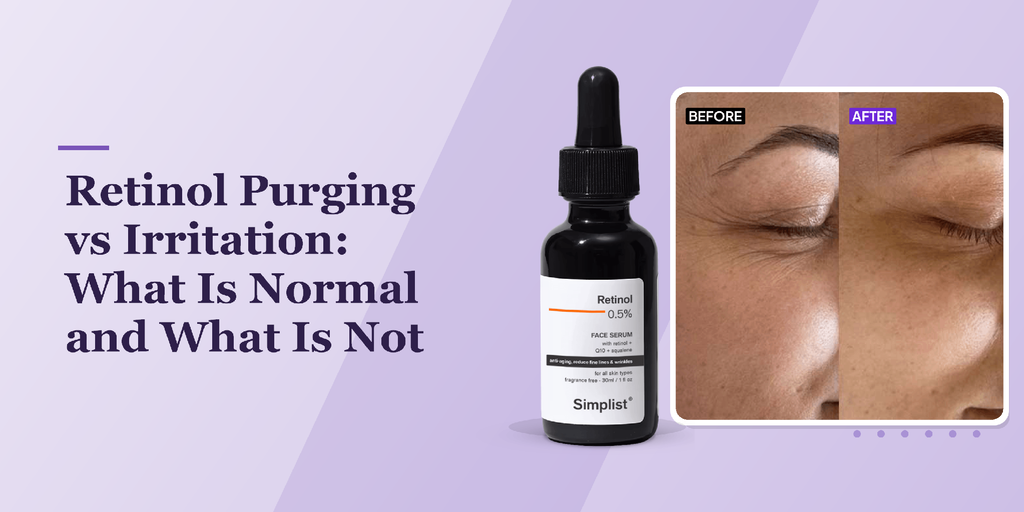

You started a retinol, and now your skin looks worse. Is that retinol purging, or is the product simply too much for you? The quickest clue is location. Purging tends to show up in spots where you already break out, while irritation shows up as redness, stinging and dryness, often in new places. This guide skips the step-by-step routine and busts the five most common myths instead, then ends with a short checklist for when to pause.
Myth 1: “Any breakout after retinol is retinol purging”
Fact: Not always. Retinol speeds up skin cell turnover, so clogged pores that were already forming can surface faster. That is the idea behind a purge. But a rash, new breakouts in areas that are usually clear, or spots that come with burning are a different story.
Here is a simple test. Look at where the spots appear. Commonly shared guidance says a purge stays in your usual trouble zones, such as the chin or forehead, and looks like small whiteheads or blackheads. Irritation spreads wider and brings redness, tightness or flaking along with it.
Myth 2: “A purge can last forever, so just push through”
Fact: This is where many top articles stay vague. Most skincare sources describe a purge as lasting roughly four to eight weeks, with some people reporting it stretches closer to twelve. Treat these numbers as rough guides, not rules, because most come from brand and clinic blogs rather than formal studies.
The useful part is what comes after. If redness and soreness are still there past about eight weeks, several sources suggest that the product or the frequency may not suit your skin. Pushing through is not a plan. Adjusting is.
Myth 3: “Stinging and peeling mean the retinol is working”
Fact: Dryness and mild flaking are common in the first weeks, and they do not prove anything about results. Burning, raw patches or skin that hurts to touch are signs your skin barrier needs a break.
This is also why the formula and the starting pace matter. A product like the Retinol Serum from Simplist uses 0.5% retinol and is meant for night use only, starting at two to three nights a week. That slow start gives your skin time to adjust. Using it nightly from day one is the fastest way to confuse irritation with a purge.
Myth 4: “More product speeds up retinol purging”
Fact: Extra product only adds irritation. A few drops cover the whole face. The Simplist page suggests two to three drops, applied as the last serum step, then a moisturizer on top.
Other habits can make things worse too. Using retinol on the same night as strong exfoliating acids, benzoyl peroxide or vitamin C can leave skin stinging, so keep them on separate nights or times of day. Picking at spots delays healing and can leave marks. Keep the rest of your routine boring while your skin adjusts: a gentle cleanser, a moisturizer you already trust and sunscreen.
Myth 5: “Sunscreen can wait until the purge is over”
Fact: Sunscreen matters most during this phase. Retinol can leave skin more sensitive to sun, and sun exposure can make redness and dark marks look worse. The Simplist instructions call for SPF 50 the next morning, and that is a sound habit with any retinol.
Moisturizer matters just as much. Applying it after your serum helps with dryness and tightness, and it is one of the easiest ways to make the adjustment period more comfortable.
Does the Formula Change the Retinol Purging Question?
Texture plays a role here. The Simplist formula is an oil-based serum that includes squalene and Q10. A retinol face serum feels different from a thin gel or a cream, and some people find an oil base easier to layer under moisturizer. It is fragrance-free, paraben-free and alcohol-free, which removes a few common triggers. It is still an active ingredient, so no formula guarantees you will skip the adjustment phase. It is also not for people who are pregnant or breastfeeding, or under 18, and it should not go on broken or irritated skin.
When to Pause and Adjust: A Quick Checklist
Use this list when you are unsure. None of it is medical advice, and your own skin is the best guide.
• Cut back the frequency. Drop to one or two nights a week, or skip a few nights, then build up slowly.
• Pause if skin burns, stings or looks raw. Give it several days to calm down before you restart.
• Moisturize morning and night. Keep the rest of your routine simple and fragrance-free.
• Wear SPF every morning. Reapply if you are outdoors for long.
• Stop mixing actives. Keep exfoliating acids, benzoyl peroxide and vitamin C away from your retinol night.
• Check the calendar. If the problem is not improving after about eight weeks, take it as a signal to rethink the product or the pace.
• See a doctor or dermatologist if your skin is very sore, swollen, blistered or reacting strongly, or if you are unsure what is going on.
The Takeaway
A purge is usually limited to your usual breakout areas, looks like small clogged spots and settles within a couple of months. Irritation brings burning, widespread redness and dryness, and it calls for backing off. When in doubt, use less, moisturize more and wear sunscreen. Pausing for a week costs you very little. Pushing through a sore, reacting face costs a lot more.
READ ALSO: 5 Ways Cosmetic Dentistry Complements Preventive Dental Care