

Ever stared at a blank page and realized you’ve used the word “space” five times in three paragraphs? You’re not alone. Finding the right space synonym can transform repetitive drafts into sharp, precise writing that holds a reader’s attention. Whether you’re describing the vastness of the cosmos, the layout of a room, or the invisible boundaries people need, the right word choice makes all the difference.
This guide walks you through the many meanings of “space” and the best alternatives for each. You’ll learn how to expand your vocabulary, match tone to context, and avoid the common traps that leave writing feeling flat.
Why the Right Space Synonym Matters
Word choice shapes clarity and style. Overusing “space” makes prose feel lazy. A well-chosen synonym, on the other hand, adds precision and rhythm. In fiction, it helps build atmosphere. In technical writing, it prevents confusion. In everyday communication, it shows care for the reader’s experience.
Think of language as a toolbox. “Space” is a useful all-purpose tool, yet different jobs call for different tools. Selecting the right one improves readability and keeps your audience engaged. It also supports better SEO when you target related phrases such as “another word for space” or “synonym for outer space” naturally within useful content.
Understanding the Many Faces of “Space”
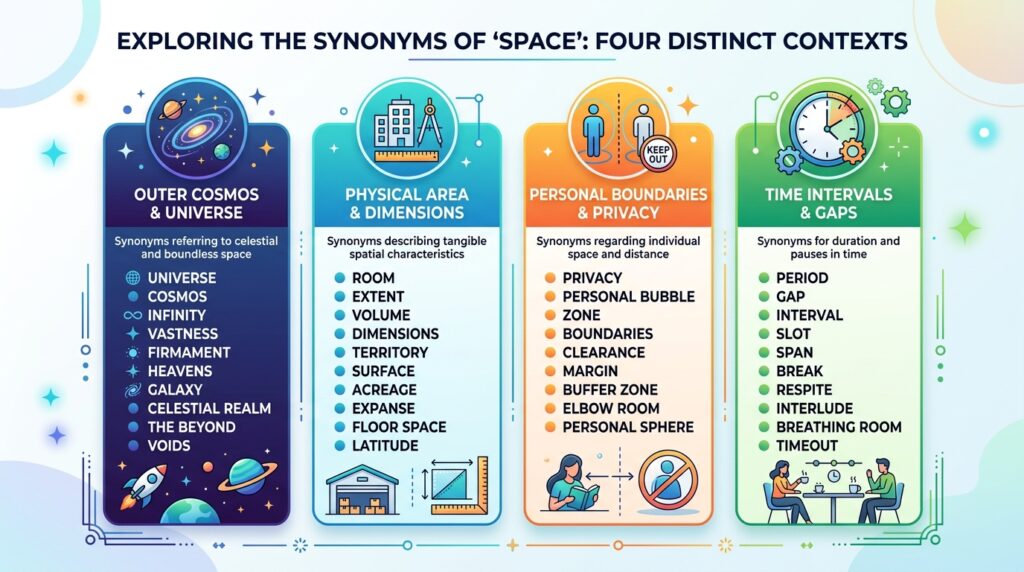
The word “space” carries several distinct meanings. Treating them as separate ideas helps you pick stronger alternatives. Here are the main contexts writers encounter most often.
Outer Space and Cosmic Contexts
When you mean the universe beyond Earth, everyday synonyms fall short. Stronger options include:
- Cosmos
- Universe
- Void
- Expanse
- Heavens (more poetic)
- Firmament (archaic or literary)
Example: Instead of “the rocket entered space,” try “the rocket entered the void” or “the rocket pierced the cosmos.” The second version feels more vivid and intentional.
Physical Area or Empty Space
This covers rooms, gaps, land, and open areas. Useful space synonyms here are:
- Area
- Room
- Gap
- Opening
- Vacancy
- Expanse
- Territory
- Volume (especially in technical writing)
Example: “There was no space left on the shelf” becomes “There was no room left on the shelf” or “The shelf had no remaining capacity.” Both read cleaner.
Personal Space and Boundaries
People need emotional and physical distance. In this context, strong alternatives include:
- Privacy
- Distance
- Boundaries
- Room (as in “give me room”)
- Breathing room
- Autonomy
Example: “Please respect my space” works, yet “Please respect my boundaries” or “I need some privacy” often communicates the need more clearly in professional or sensitive settings.
Time and Duration
“Space” sometimes means an interval of time. Better choices are:
- Interval
- Period
- Gap
- Window
- Span
- Break
Example: “In the space of two hours” can become “In the span of two hours” or “Within a two-hour window.”
Other Specialized Uses
Writers also meet “space” in design, typography, and abstract ideas:
- Whitespace (in design and layout)
- Margin
- Breathing room
- Latitude
- Leeway
- Scope
A simple comparison table helps organize these options:
| Context | Strong Synonyms | Tone Notes |
|---|---|---|
| Outer cosmos | Cosmos, void, expanse | Formal or literary |
| Physical area | Room, gap, area, volume | Neutral, practical |
| Personal boundaries | Privacy, distance, boundaries | Empathetic, clear |
| Time interval | Span, window, period | Precise |
| Design / abstract | Whitespace, latitude, scope | Technical or figurative |
How to Choose the Best Space Synonym for Your Writing
Context comes first. Ask yourself three quick questions before settling on a word:
- What exact meaning do I intend?
- What tone fits the piece (formal, conversational, technical, poetic)?
- Will the synonym feel natural to my audience?
After answering those, test the sentence aloud. If the new word creates a stumble or feels forced, try another option. A thesaurus is a starting point, not a final authority. Always check a dictionary definition and a few real-world examples.
Consider register as well. “Void” works in science fiction or philosophy. It may sound overly dramatic in a product description. “Room” feels everyday and friendly. “Latitude” suits formal or professional writing when you mean freedom of action.
Real-world example: A travel blog describing a quiet hotel lobby might say “plenty of breathing room” instead of “plenty of space.” The first phrase feels more inviting. A technical manual for warehouse layout benefits from “available floor area” or “usable volume” rather than the vague “space.”
Practical Tips for Building Lexical Variety
Expanding your options for “space” strengthens overall writing style. Try these habits:
- Keep a running list of synonyms you encounter in good writing. Note the context.
- Read outside your usual genres. Science writing, poetry, and design blogs all handle “space” differently.
- Replace one overused word in each draft revision. Small swaps add up.
- Use free thesaurus tools carefully. Cross-check meanings so you avoid near-misses.
- Practice rewriting short passages. Take a paragraph heavy with “space” and force yourself to use three different alternatives.
These steps support long-term vocabulary expansion without feeling like homework. Over time, the right word starts to surface more quickly during drafting.
Common Mistakes to Avoid
Even careful writers slip into patterns that weaken their work. Watch for these:
- Using “space” as a vague filler when a more specific term exists.
- Choosing a synonym that shifts the meaning slightly (for example, swapping “personal space” for “privacy” when physical distance is the real issue).
- Forcing formal synonyms into casual writing, which can sound stiff.
- Ignoring audience knowledge. Technical readers may welcome “volume,” while general readers prefer “room.”
A quick self-edit pass focused only on repeated words often reveals easy improvements.
Putting It All Together: A Short Before-and-After
Before:
“The space between the buildings felt empty. She needed space after the argument. In space, the stars looked closer.”
After:
“The gap between the buildings felt empty. She needed distance after the argument. In the cosmos, the stars looked closer.”
The revised version keeps the meaning while adding texture and avoiding repetition.
Key Takeaways and Next Steps
Choosing the right space synonym starts with understanding context, then matching tone and audience. Outer space, physical areas, personal boundaries, and time intervals each call for different words. Regular practice with a thesaurus, careful reading, and deliberate revision builds stronger habits.
Try this today: Open a recent piece of your writing. Highlight every instance of “space.” Replace at least half of them with more precise alternatives. Notice how the texture of the text changes.
Share your favorite swap in the comments or tell us which context gives you the most trouble. Your examples help other writers improve too.
FAQs
What is another word for space?
The best alternative depends on context. For outer space, try cosmos, void, or expanse. For a physical area, use room, gap, or area. For personal boundaries, privacy or distance often works better. Always match the synonym to the exact meaning you want to convey.
What is a good synonym for outer space?
Strong options include cosmos, universe, void, and expanse. In more poetic writing, heavens or firmament can add atmosphere. Choose based on whether you need a scientific, dramatic, or literary tone.
What is a synonym for personal space?
Common and effective choices are privacy, boundaries, distance, and breathing room. These words usually communicate the need for emotional or physical separation more clearly than the general term “space.”
What is another word for empty space?
Useful alternatives include gap, vacancy, opening, void, and expanse. In design or layout contexts, whitespace or margin may fit better. Pick the word that best describes the size and purpose of the emptiness.
How do I choose the right space synonym in writing?
First identify the exact meaning (cosmic, physical, personal, or time-related). Next consider your tone and audience. Finally, test the sentence aloud to make sure the new word feels natural. A quick dictionary check prevents near-misses that change the intended sense.
What are formal synonyms for space?
In formal or technical writing, consider volume, latitude, scope, interval, or territory. These words often sound more precise than everyday options like room or gap and suit academic, professional, or scientific contexts.
Why should writers avoid overusing the word space?
Repeating “space” makes writing feel repetitive and imprecise. Stronger synonyms add variety, improve clarity, and help readers stay engaged. Even small swaps can elevate the overall quality and flow of a piece.
You May Also Like: Tased or Tazed? The Correct Spelling Explained