
Picture yourself in a bustling New York salon in the 1890s, surrounded by the elite discussing the latest society events and what to wear to the opera. A new publication lands on the coffee table, promising to capture that world of glamour and aspiration. That was the spark for Vogue. Today, it stands as the ultimate authority in fashion journalism, influencing everything from haute couture runways to your everyday wardrobe choices.
In this comprehensive look at the history of Vogue magazine, you will trace its remarkable journey from a late-19th-century social gazette to a global multimedia empire. Along the way, discover how it redefined high fashion, championed editorial photography, orchestrated culture shifts, and turned events like the Met Gala into worldwide spectacles. Whether you are a fashion enthusiast, industry professional, or simply someone who loves a good luxury lifestyle story, this piece reveals why Vogue continues to set runway trends and inspire generations. Get ready for an inside look at the editors, covers, and moments that made it legendary.
The Founding Years: A Society Gazette Takes Shape (1892–1909)
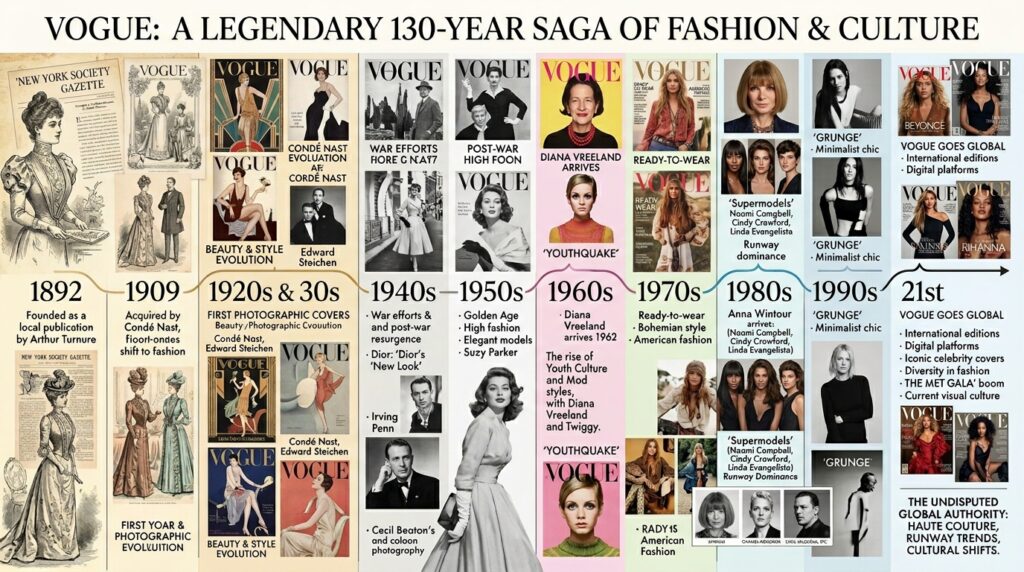
Vogue debuted on December 17, 1892, thanks to Arthur Baldwin Turnure, a New York businessman with a vision for a “dignified, authentic journal of society, fashion, and the ceremonial side of life.” Priced at 10 cents, the weekly publication targeted New York’s upper class. It mixed social notes, etiquette tips, and light fashion coverage rather than deep style analysis.
Josephine Redding served as the first editor and even coined the name Vogue. Early issues featured illustrations by artists like A.B. Wenzell, depicting debutantes and high-society scenes. Harry Whitney McVickar handled art direction. The content focused on balls, weddings, and the “who’s who” of Manhattan elite. Readers felt like insiders peeking behind velvet ropes.
Turnure died in 1906 from pneumonia. His family continued operations briefly under Marie Harrison as majority shareholder. Yet the magazine struggled with limited reach and resources. Circulation hovered low, and it lacked the visual punch modern readers expect. Still, those early years planted the seed: Vogue as a mirror to aspirational living. This foundation proved crucial when a transformative figure entered the picture.
You might wonder how a niche weekly survived the competitive publishing landscape of the Gilded Age. The answer lies in its exclusive appeal. It never chased mass readership. Instead, it cultivated loyalty among those who mattered most in shaping taste. That strategy would define Vogue for decades.
Condé Nast’s Revolution: Elevating Fashion Journalism (1909–1930s)
Everything changed in 1909 when Condé Montrose Nast purchased Vogue. A savvy publisher, Nast saw untapped potential in turning the society paper into a premier fashion journalism outlet. He shifted it to biweekly (later monthly) frequency, upgraded paper quality, and invested heavily in visuals. Under his leadership, Vogue embraced photography over illustrations, setting new standards for editorial photography.
Edna Woolman Chase took the editor-in-chief role in 1914 and held it for nearly four decades. She professionalized the operation, emphasizing elegance and authority. Chase famously declared, “Vogue is the fashion bible.” Her tenure coincided with Nast’s innovations, including the launch of British Vogue in 1916, the first international edition. This move marked the beginning of Vogue’s global reach.
By the 1920s and 1930s, Vogue introduced color covers and studio photography by pioneers like Baron Adolph de Meyer. The July 1932 issue featured one of the earliest color photographs on an American cover, showcasing vibrant fabrics and modern silhouettes. These changes aligned Vogue with the Art Deco era’s glamour. It began covering Paris couture houses like Chanel and Schiaparelli, bringing haute couture to American audiences.
Nast’s business model focused on quality over quantity. He targeted affluent readers who attracted luxury advertisers. This approach built Vogue’s reputation as the definitive voice in high fashion. During the Great Depression, while many publications faltered, Vogue thrived by offering escapism through aspirational imagery. Readers turned to its pages for hope and inspiration amid economic hardship.
Post-War Glamour and the Rise of Haute Couture (1940s–1960s)
World War II tested Vogue’s resilience. Paper shortages limited issues, yet the magazine persisted, promoting American designers like Norman Norell when European imports halted. Post-war, it celebrated the return of Parisian glamour. Christian Dior’s New Look in 1947 dominated coverage, with Vogue helping popularize the cinched waist and full skirts that defined 1950s femininity.
The 1950s solidified Vogue’s role in luxury lifestyle reporting. Features explored not just clothes but homes, travel, and culture. Photographers like Irving Penn and Richard Avedon created iconic images that blended art and commerce. Their work elevated editorial photography to gallery-worthy status.
By the early 1960s, youth culture challenged traditional elegance. Vogue adapted, covering the “Youthquake” movement. This era bridged old-world sophistication with emerging modernity, paving the way for bolder editorial voices.
Diana Vreeland’s Bold Vision: Redefining Runway Trends (1963–1971)
Enter Diana Vreeland, appointed editor-in-chief in 1963. Known for her flamboyant style and legendary pronouncements (“Pink is the navy blue of India”), she injected energy and fantasy into Vogue’s pages. Vreeland championed exotic locations for shoots, sending photographers to far-flung places like Rajasthan and the African savanna. These spreads transformed runway trends coverage into cultural adventures.
She redefined models, favoring lithe, androgynous figures over curvaceous ideals. Twiggy and Veruschka became muses. Vreeland’s Vogue celebrated individuality and creativity, aligning with the 1960s counterculture while maintaining haute couture prestige. Iconic covers from this period captured the era’s spirit, from space-age fashion to bohemian chic.
Her influence extended beyond print. Vreeland advised on the Metropolitan Museum of Art’s Costume Institute, laying groundwork for future Met Gala glory. Though she left in 1971 amid shifting tastes, her tenure marked a culture shift toward imaginative, trend-setting fashion journalism.
Grace Mirabella’s Era: Balancing Accessibility and High Fashion (1971–1988)
Grace Mirabella succeeded Vreeland and steered Vogue toward a more practical, inclusive direction. She focused on real women’s lives, incorporating career fashion and health alongside couture. Covers featured relatable elegance rather than pure fantasy.
Under Mirabella, Vogue expanded beauty and wellness coverage. It responded to second-wave feminism by showcasing strong, independent women. The 1974 cover with Beverly Johnson, the first African American model on American Vogue, represented a milestone in diversity.
This period emphasized Vogue’s role as a trusted advisor rather than distant oracle. Circulation grew, and advertising flourished. Mirabella’s 17-year tenure prepared the magazine for the celebrity-driven 1980s and beyond.
Anna Wintour’s Transformation: Celebrity, Power, and the Met Gala (1988–2025)
In 1988, Anna Wintour became editor-in-chief of American Vogue. Her first cover featured a model in jeans and a Christian Lacroix jacket, signaling a fresh, democratic approach to high fashion. Wintour integrated celebrities into fashion narratives, putting stars like Madonna and later supermodels on covers. This move broadened appeal and amplified Vogue’s cultural relevance.
Wintour chaired the Met Gala from 1995 onward, transforming the 1948 fundraiser into “fashion’s biggest night.” Themes tied to Costume Institute exhibitions, and star-studded guest lists drew global attention. The event became a culture shift catalyst, blending haute couture, celebrity, and philanthropy. Red-carpet looks generated billions in media value and dictated runway trends for seasons ahead.
Her leadership navigated digital disruption. Vogue launched robust online presence in the 2000s, with Vogue.com becoming a daily destination for fashion journalism. Wintour expanded global editions of Vogue magazine, now numbering 28 as of 2026. She championed diversity initiatives and mentored talent across Condé Nast.
In 2025, Wintour stepped back from the U.S. editor-in-chief role to focus on global duties as Chief Content Officer and Global Editorial Director. Chloe Malle assumed leadership of American Vogue as head of editorial content, ensuring continuity while injecting new perspectives.
The Digital Evolution of Vogue: From Print to Multimedia Powerhouse
The early 2000s brought seismic changes. Vogue embraced the internet, launching video series, podcasts, and social channels. Vogue.com now delivers instant runway trends coverage during Fashion Week. Live streams and behind-the-scenes content democratize haute couture.
Social media amplified Vogue’s voice. Instagram and TikTok accounts reach millions daily with styling tips, editor interviews, and trend forecasts. The digital shift preserved print’s prestige while expanding reach to younger audiences. Features like “Vogue World” and interactive archives keep the brand vital.
Today, Vogue operates as a 360-degree media entity. Print issues remain collector’s items, while digital platforms drive daily engagement. This evolution underscores its adaptability without losing core authority in luxury lifestyle storytelling.
Global Editions of Vogue Magazine: A Worldwide Cultural Force
Vogue’s international editions extend its influence across continents. British Vogue launched in 1916, followed by French (1920), Italian (1965), and many more. As of 2026, 28 editions operate, each adapting to local markets while upholding the brand’s standards.
Vogue India, for instance, blends Bollywood glamour with traditional craftsmanship. Vogue Arabia highlights Middle Eastern haute couture. These editions foster cross-cultural dialogue, introducing global designers to new audiences and vice versa.
Collectively, they shape fashion journalism on a planetary scale. Editors collaborate on projects, and shared content ensures cohesive messaging. This network cements Vogue’s role as the connective tissue of the international fashion ecosystem.
Iconic Vogue Magazine Covers: Moments That Defined Eras
Certain covers transcend time. The 1932 color photograph issue dazzled with vivid hues. Vreeland-era images captured psychedelic excess. Wintour’s debut cover blended high and low fashion effortlessly.
Beverly Johnson’s 1974 appearance broke barriers. Later covers featured diverse talents, from Rihanna to Zendaya, reflecting societal progress. Each one tells a story of culture shift, innovation in editorial photography, and Vogue’s trendsetting power. Collectors and historians study them as cultural artifacts.
How Vogue Influences Fashion Trends: From Runways to Real Life
Vogue does more than report runway trends; it shapes them. Editors attend collections in Paris, Milan, New York, and London. Their reviews and editorials determine which looks endure. Photographers capture the energy, translating catwalk drama into aspirational imagery.
Beyond runways, Vogue spotlights emerging designers, sustainability efforts, and cultural crossovers. Features on street style and celebrity wardrobes influence everyday consumers. This trickle-down effect makes high fashion accessible, driving sales for luxury brands worldwide.
Inside the World of Vogue Editors: The Visionaries Behind the Legacy
Editors like Chase, Vreeland, Mirabella, and Wintour were more than gatekeepers. They were tastemakers, risk-takers, and cultural arbiters. Their decisions on layouts, models, and stories dictated what the world deemed beautiful and desirable.
Modern teams continue this tradition under new leadership. Collaborative editorial meetings blend data analytics with creative intuition. The result? Content that educates, inspires, and entertains while upholding Vogue’s sophisticated voice.
Vogue’s Enduring Legacy in Fashion Journalism and Luxury Lifestyle
From its 1892 roots, Vogue has chronicled and catalyzed change. It elevated fashion journalism to an art form, championed haute couture, and turned the Met Gala into a global event. Its digital evolution and global editions ensure relevance in a fast-paced world.
Vogue reminds us that fashion is about more than clothes. It reflects identity, aspiration, and cultural dialogue. As you flip through its pages or scroll its feeds, you participate in a legacy spanning over 130 years.
Ready to deepen your appreciation? Explore the Vogue archive online or attend a local fashion week event. Support emerging designers featured in its pages. The world of luxury lifestyle awaits your discovery. What trend will Vogue spotlight next? The answer shapes how we all dress tomorrow.

