
Introduction
Selecting the right IML robot is an important decision for manufacturers planning to automate plastic packaging production. The equipment must place labels accurately, operate within the injection molding cycle, and handle the intended products without disrupting the rest of the production line.
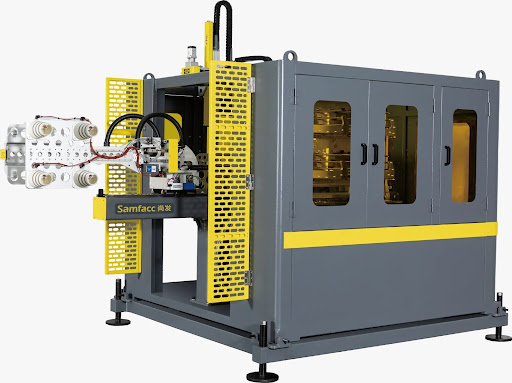
An IML robot is used in In-Mold Labeling, a process in which a printed label is placed into an open mold before molten plastic forms the finished container. The label becomes integrated with the product during molding, allowing manufacturers to combine decoration and production in one coordinated process.
Because packaging products vary in size, shape, material, and production volume, there is no single IML robot configuration suitable for every application. Buyers should assess their specific requirements before comparing machines or requesting quotations.
Define the Production Requirements
The first step is to understand what the production line needs to manufacture. Buyers should identify the container dimensions, product weight, plastic material, label size, number of mold cavities, and target output.
The intended application also matters. A small, thin-wall cup may require a different robot layout and operating speed from a large industrial bucket. The required gripping tools, reach, and label placement method will depend on the product and mold geometry.
Manufacturers should also consider future product plans. If several container formats are expected, the system may need flexible tooling, saved operating programs, and a practical changeover process.
Clear requirements make it easier to compare suppliers on a like-for-like basis.
Compare Side-Entry and Top-Entry Robots
Side-entry and top-entry configurations are common options for IML automation.
A side-entry robot accesses the mold from the side and can be suitable for applications where rapid horizontal access is practical. Some high-volume cup and tub production lines use this configuration.
A top-entry robot approaches the mold from above and may be suitable for certain larger containers or mold layouts that favor vertical access.
The correct choice depends on the machine, mold, container dimensions, available clearance, and required production cycle. Buyers should ask suppliers to explain the advantages and limitations of each option for the specific application instead of choosing solely by the robot’s general category.
A physical layout review can help identify access problems before installation.
Check Injection Molding Machine Compatibility
An IML robot must be compatible with the injection molding machine on which it will operate. Important details include machine dimensions, mold opening stroke, available clearance, robot mounting arrangements, and control interfaces.
The robot also needs sufficient reach and appropriate tooling to access the mold cavities safely. A system that fits the factory floor may still be unsuitable if the robot cannot enter and leave the mold within the required sequence.
Machine communication is equally important. The robot and molding machine must exchange the correct signals so label placement, injection, ejection, and mold movement occur in the intended order.
Before purchasing equipment, share the machine model and technical specifications with the supplier. Compatibility should be confirmed using the actual production requirements.
Evaluate Label Placement Accuracy
Label placement accuracy directly affects the appearance and consistency of the finished package. A robot should position the label correctly while avoiding folds, edge damage, and unwanted movement during transfer.
However, accuracy is influenced by several interacting factors. Label dimensions, film stiffness, static conditions, gripping-tool design, mold surface, and the injection process all contribute to the final result.
Buyers should ask how the system handles label pickup, retention, placement, and release. They should also check whether the proposed equipment supports the intended label material and size.
A production trial using representative labels is one of the most useful ways to evaluate performance. Inspecting multiple parts and cavities helps reveal issues that may not appear in a single sample.
Consider Cycle Time and Actual Output
Cycle time is often an important purchasing criterion, but the fastest advertised robot is not necessarily the best choice.
The complete production cycle includes label feeding, robot movement, mold opening and closing, injection, cooling, and product removal. If another stage takes longer than the robot’s task, increasing robot speed may not improve total output.
Buyers should request realistic cycle estimates based on the actual product, mold, machine, and label. Ask which conditions are assumed and whether the target has been demonstrated in a production trial.
Actual output should be measured in acceptable finished products rather than theoretical cycles alone. Downtime, rejected containers, label errors, and changeovers all affect the number of saleable units produced.
Review Automation and Integration Options
An IML robot may operate alongside label magazines, conveyors, stacking equipment, inspection systems, and packaging stations. These components should be considered during project planning.
A reliable integration plan defines how products and labels move through the production line. It also identifies control signals, machine interlocks, fault responses, and the required safety procedures.
If a conveyor cannot keep pace with the molding cycle, finished products may accumulate and cause interruptions. Likewise, an unreliable label-feeding system can stop an otherwise fast robot.
Manufacturers should discuss the complete workflow with the supplier and clarify which equipment is included in the quotation. This prevents important components from being overlooked during budgeting.
Calculate Total Ownership Cost
The purchase price is only one part of the investment. Total ownership cost may include installation, tooling, commissioning, training, spare parts, maintenance, energy consumption, and production interruptions.
Buyers should compare these expenses with realistic expected benefits. Potential savings may come from reduced manual handling, fewer labeling errors, lower waste, or improved output, but the results depend on the existing production process.
A simple business case can estimate the annual value of additional saleable output and reduced operating costs. It should also include downtime, maintenance, financing, and other relevant expenses.
Avoid relying on guaranteed payback claims unless the assumptions are clearly documented and match the factory’s actual conditions.
Assess Maintenance and Technical Support
Long-term performance depends on maintenance and access to technical support. Before selecting a supplier, ask about recommended inspection intervals, common wear parts, spare-part availability, software support, and response arrangements for equipment faults.
Operator training should cover normal operation, changeovers, routine inspections, and the correct response to alarms. Maintenance staff may require additional training for troubleshooting and component replacement.
Safety must remain a priority. Operators should follow the equipment manufacturer’s procedures, keep guards and interlocks functional, and use proper isolation procedures before servicing hazardous areas.
Conduct a Practical Acceptance Test
Before final acceptance, manufacturers should agree on measurable performance criteria. These may include label position, product dimensions, defect rate, cycle stability, and continuous operation under defined conditions.
Testing should use the intended product material, label, mold, and machine wherever possible. A successful short demonstration may not reveal problems that appear during extended production.
The supplier and buyer should document the test conditions, results, outstanding issues, and handover requirements. This creates a clear basis for confirming that the equipment meets the agreed specification.
Conclusion
Choosing the right IML robot requires more than comparing prices or advertised speeds. Manufacturers should assess product requirements, machine compatibility, label accuracy, cycle time, integration, maintenance, and total ownership cost.
A well-planned selection process helps reduce installation risks and supports dependable production. By confirming specifications and testing the complete system before acceptance, packaging manufacturers can make a more informed investment in IML automation.
Frequently Asked Questions
What information is needed to select an IML robot?
Useful information includes product drawings, label dimensions, mold details, injection machine specifications, cavity count, and the required production output.
Should I choose the fastest IML robot available?
Not necessarily. The best system is one that meets the required output and quality standards while remaining compatible with the mold and machine.
Why is supplier support important?
Training, spare parts, maintenance guidance, and technical assistance help reduce the risk of extended production interruptions.